
PCB Repair Tools Wholesale: What Should Distributors Stock First?
A profitable repair-tool catalog does not need dozens of SKUs on day one. For new distributors, the better approach is to start with a small number of products that cover common PCB repair workflows, test real demand and expand only after the first assortment begins to sell.
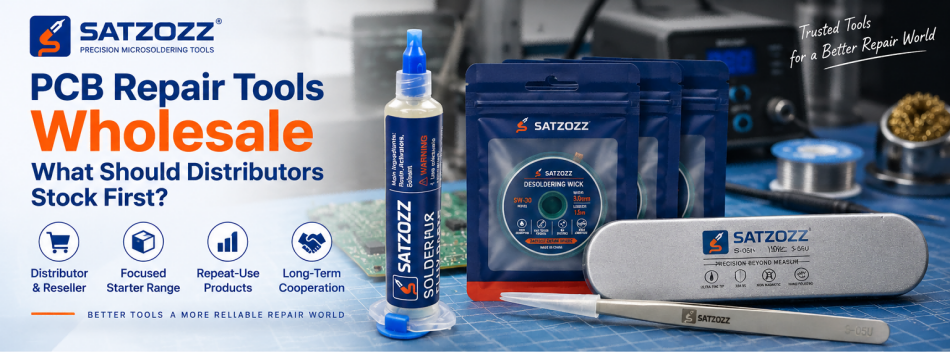
RANGE
For a new PCB repair tools wholesale range, start with three functional categories: soldering flux, desoldering wick and precision tweezers. These products support common soldering, solder-removal and component-handling tasks. Keep the first SKU mix focused, test customer demand and expand widths, variants and private-label options only after the core products are validated.
Why New Distributors Should Not Start With Too Many SKUs
More products do not automatically create a stronger wholesale business.
When a distributor enters the PCB repair market, it can be tempting to build a large catalog immediately.
The problem is that every additional SKU creates more:
- Inventory to finance
- Products to explain
- Stock levels to monitor
- Packaging to manage
- Reorder decisions to make
A focused starter range makes it easier to understand which products your actual customers want.
The 3 Core Categories for a PCB Repair Tools Wholesale Range
Build around repair functions rather than random products.
Soldering Flux
Flux supports solder wetting, localized PCB soldering, SMD rework and microsoldering.
Consumable Repeat Purchase PCB RepairBecause flux is consumed during repair work, it can be a useful repeat-purchase item for repair shops.
Soldering Flux Supplier Guide →Desoldering Wick
Desoldering wick is used for solder removal, pad preparation, solder bridge removal and component rework.
Consumable Multiple Widths Cross-SellA width-based product family also gives distributors a natural way to expand the assortment gradually.
View SATZOZZ Desoldering Wick →Precision Tweezers
Precision tweezers support component handling, positioning and fine PCB repair work.
Precision Tool Microsoldering Higher DurabilityTweezers complement consumables and help create a more complete technician-focused product range.
View S-05U Precision Tweezers →Build the Assortment in Three Stages
Not every available model needs to enter your first order.
Core
Products Needed to Cover the Basic Repair Workflow
Start with enough variety to be useful without creating excessive inventory.
- One no-clean soldering flux product
- A general-purpose desoldering wick width
- A fine desoldering wick width
- One precision tweezer model
Scale
Add Branding and Deeper Inventory After Validation
Private label makes more sense after you know what sells.
- Private-label packaging
- Deeper quantities of proven SKUs
- Additional variants
- Distributor-specific product bundles
If you are considering this stage, read: Private Label PCB Repair Tools: Distributor Guide .
Which Desoldering Wick Widths Should a Distributor Stock First?
Width variation makes solder wick one of the easiest categories to expand progressively.
SATZOZZ currently offers five wick widths: 1.0 mm, 1.5 mm, 2.0 mm, 2.5 mm and 3.0 mm, with 1.5 meters per roll.
| Model | Width | Typical Application | Starter Priority |
|---|---|---|---|
| SW-10 | 1.0 mm | Very fine SMD and delicate PCB pads | Expand Later |
| SW-15 | 1.5 mm | Fine motherboard and small-pad work | High |
| SW-20 | 2.0 mm | General-purpose PCB repair | High |
| SW-25 | 2.5 mm | Medium pads and larger solder areas | Expand Later |
| SW-30 | 3.0 mm | Connectors and larger solder deposits | Useful Add-On |
For a small pilot range, 1.5 mm and 2.0 mm can cover many common precision and general PCB repair jobs, while a wider option can be added for customers working on larger solder areas.
For more detailed selection guidance, see: How to Choose the Right Desoldering Wick Width .
4 Rules for Building a Better Wholesale Starter Range
The goal is not maximum SKU count—it is useful coverage with manageable inventory.
Prioritize Repeat-Use Products
Consumables such as flux and solder wick can generate repeat purchasing when technicians are satisfied with their performance.
Cover Different Repair Functions
Three products that solve three different repair tasks can create more value than three versions of the same tool.
Avoid Deep Stock Before Validation
Sample testing and smaller pilot orders give you more information before capital is tied up in inventory.
Make Products Easy to Cross-Sell
Flux, wick and tweezers naturally fit the same PCB repair customer and can be presented as a coordinated assortment.
What Should You Measure After the First Wholesale Order?
Your first order should generate data, not only revenue.
These signals should determine whether you expand the product range, increase inventory depth or begin a private-label project.
Standard Products First or Private Label First?
The answer depends on how well you already know your market.
A new distributor with limited sales data may benefit from starting with standard products because this reduces packaging and customization complexity.
A distributor with an established customer base and proven SKU demand may have stronger reasons to move into private labeling.
The basic sequence is:
Sample → pilot assortment → customer feedback → proven SKU → private label or deeper inventory.
Read our complete guide: Private Label PCB Repair Tools .
What Should You Ask a PCB Repair Tools Wholesaler Before Ordering?
A useful quotation needs more than a price list.
- Which products and models are currently available?
- Can samples be tested before the regular order?
- What are the wholesale quantity requirements?
- Can different models be combined in one order?
- What is the estimated supply lead time?
- What retail packaging is available?
- Which products support private-label cooperation?
- How should repeat orders be placed?
For a broader supplier evaluation framework, read: How to Choose a PCB Repair Tools Supplier .
Build a Focused Microsoldering Range Before You Build a Large Catalog
SATZOZZ currently supports repair-tool distributors, phone repair shops, bulk buyers and resellers with sample order support and wholesale cooperation. Current core products include NC559 No-Clean Flux, S-05U Precision Tweezers and SATZOZZ Desoldering Wick.
PCB Repair Tools Wholesale Questions
Common questions from new distributors and repair-tool resellers.
What PCB repair tools should a new distributor stock first?
A focused starter range can include soldering flux, desoldering wick and precision tweezers because these categories cover soldering, solder removal and component handling.
How many PCB repair tool SKUs should I start with?
There is no universal number. Start with enough products to cover common repair workflows without creating unnecessary inventory, then expand according to real sell-through data.
Which desoldering wick widths are useful for a starter assortment?
A 1.5 mm option can serve fine PCB work and a 2.0 mm option can cover many general repair applications. Wider or narrower models can be added as customer demand becomes clearer.
Should distributors test samples before buying in bulk?
Yes. Sample testing helps technicians evaluate product performance and gives purchasing teams more confidence before larger inventory commitments.
Should I start with private-label PCB repair tools?
Private label can be valuable for established distributors, but new sellers may reduce risk by validating products and customer demand before investing in customized packaging.
Does SATZOZZ support wholesale buyers?
Yes. SATZOZZ currently supports repair-tool distributors, phone repair shops, bulk buyers and resellers with samples, wholesale pricing and long-term supply cooperation.
What products are currently available from SATZOZZ?
SATZOZZ currently highlights NC559 No-Clean Flux, S-05U Precision Tweezers and SATZOZZ Desoldering Wick as its core microsoldering and PCB repair products.
Building a PCB Repair Tools Wholesale Range?
Tell SATZOZZ your market, sales channel and the products you are interested in. Start with samples, validate the product mix and build inventory around the SKUs your customers actually use.
Pingback: How to Plan Your First PCB Repair Tools Wholesale Order: Quantity, SKU Mix & Reorder Strategy - SATZOZZ Precision Microsoldering Tools
Pingback: How to Build a PCB Repair Tools Reorder Strategy: Sell-Through, Safety Stock & Lead Time - SATZOZZ Precision Microsoldering Tools
Pingback: How to Bundle PCB Repair Tools for Higher Order Value: Flux + Wick + Tweezers - SATZOZZ Precision Microsoldering Tools
Pingback: How to Price PCB Repair Tools for Resale: Margin, Markup, Freight & Bundle Strategy - SATZOZZ Precision Microsoldering Tools