
How to Build a PCB Repair Tools Reorder Strategy: Sell-Through, Safety Stock & Lead Time
A successful first wholesale order is only the beginning. The next challenge is keeping fast-moving products available without overstocking slow SKUs. A practical reorder strategy uses actual sales data, supplier lead time and safety stock to decide when—and how much—to buy again.
RULE
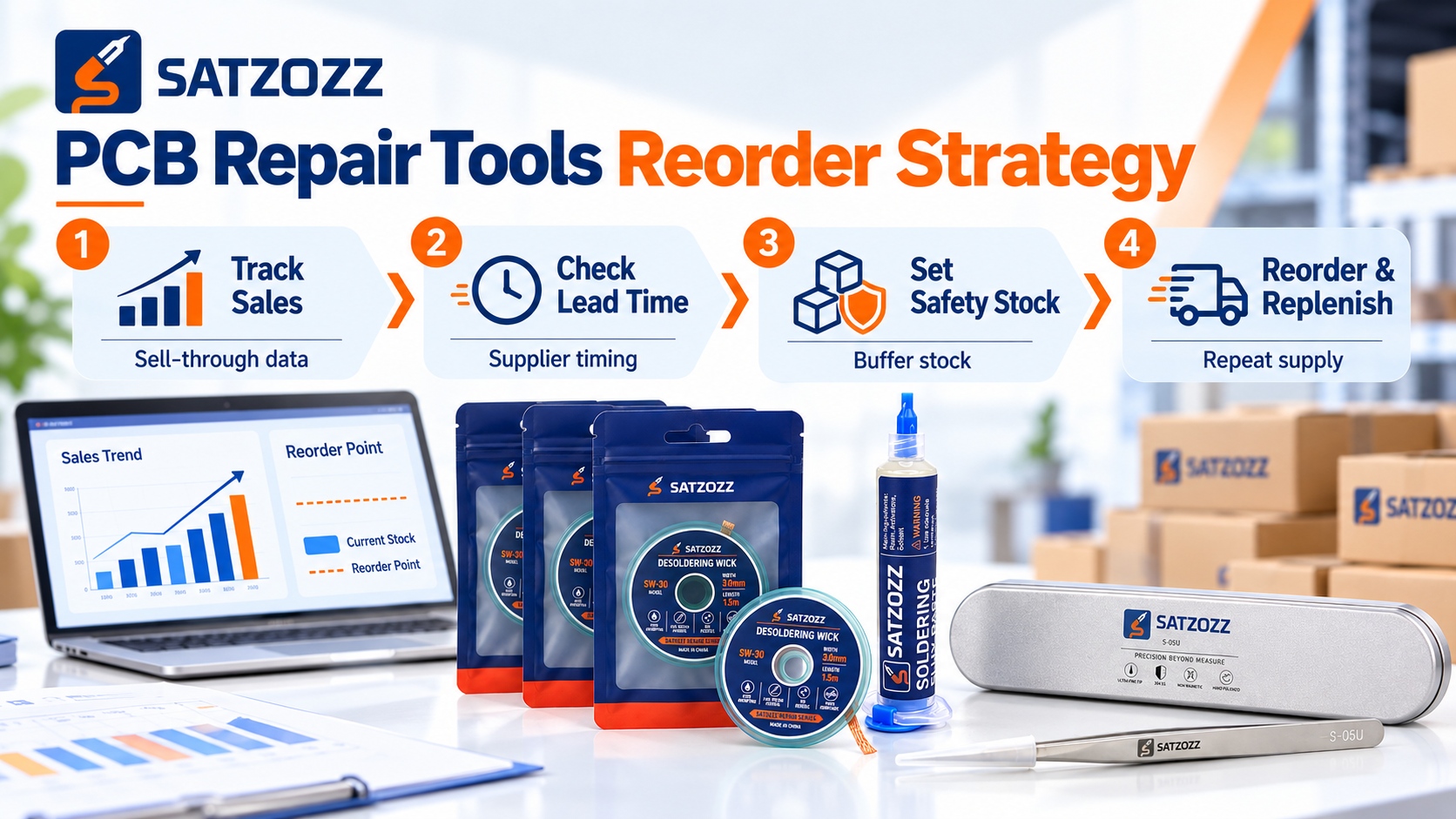
Do not wait until inventory reaches zero before placing the next order. Track average sales, supplier lead time and a reasonable safety-stock buffer. Reorder proven products earlier, keep slower SKUs lean and increase quantities only when repeat demand becomes consistent.
Why Reorder Planning Matters
Inventory problems often appear only after a product starts selling well.
A distributor can lose sales in two different ways:
- Running out of popular products
- Buying too much of slow-moving products
The purpose of reorder planning is to balance these two risks.
Start With Sell-Through, Not Guesswork
Your own sales history is usually the best starting point for a reorder decision.
Sell-through tells you how much of the inventory you received has actually been sold during a period.
For a simple distributor dashboard, record:
- Opening inventory
- Units sold
- Current inventory
- Number of selling days
- Customer repeat orders
Simple Sell-Through View
Sell-through rate = units sold ÷ units received × 100%
Example: 100 units received and 60 units sold = 60% sell-through.
Classify SKUs by Reorder Priority
Not every product needs the same replenishment strategy.
Fast-Moving Core SKU
Proven products with consistent sales or repeat orders. These deserve earlier reorder attention and potentially deeper stock.
Stable Support SKU
Products that sell regularly but at a lower rate. Keep enough stock to maintain range coverage without overcommitting inventory.
Slow / Test SKU
New or specialized products with limited sales evidence. Reorder conservatively until demand improves.
Seasonal / Project SKU
Demand may depend on a customer project, promotion or temporary market event. Avoid treating this as permanent baseline demand.
Understand Your Supplier Lead Time
Reorder timing depends on how long new stock takes to reach you.
Lead time is not only shipping time.
Depending on the product and order type, it may include:
- Order confirmation
- Stock preparation or production
- Packaging
- Export handling
- International transport
- Local receiving
SATZOZZ currently positions its wholesale program around sample support, stable product supply and long-term reseller cooperation.
Set a Practical Reorder Point
The reorder point is the stock level that triggers a new purchase.
A simple planning model is:
Basic Reorder Point
Reorder Point = expected sales during lead time + safety stock
Example: if a SKU sells 10 units per week, replenishment takes 4 weeks, and you keep 15 units of safety stock:
10 × 4 + 15 = 55 units
When inventory approaches 55 units, it is time to consider the next order.
How Much Safety Stock Should You Keep?
Safety stock protects against uncertainty, but too much becomes excess inventory.
| Situation | Suggested Approach | Reason |
|---|---|---|
| Fast-moving core SKU | Higher buffer | Stockout can immediately affect sales |
| Stable support SKU | Moderate buffer | Useful to maintain assortment coverage |
| Slow-moving SKU | Low buffer | Reduce excess inventory risk |
| New test SKU | Very conservative | Demand is not yet proven |
Reorder Desoldering Wick by Width, Not Only by Total Units
Different wick widths may sell at very different rates.
SATZOZZ currently offers five desoldering wick models: 1.0 mm, 1.5 mm, 2.0 mm, 2.5 mm and 3.0 mm.
A distributor should track each width separately.
| Model | Width | Typical Role | Reorder Decision |
|---|---|---|---|
| SW-10 | 1.0 mm | Fine SMD work | Based on specialist demand |
| SW-15 | 1.5 mm | Fine PCB repair | Track as potential core SKU |
| SW-20 | 2.0 mm | General-purpose PCB repair | Track as potential core SKU |
| SW-25 | 2.5 mm | Medium solder areas | Support SKU |
| SW-30 | 3.0 mm | Larger pads and connectors | Application-specific demand |
View the current range: SATZOZZ Desoldering Wick .
Increase Quantity Only for Proven SKUs
Better pricing should follow demand—not create inventory pressure.
As repeat orders become predictable, you can consider increasing the purchase quantity of fast-moving products.
Signals that may justify deeper stock include:
- Consistent monthly sales
- Repeat purchases from repair shops
- Low remaining inventory before each reorder
- Stable customer demand
- Predictable supplier lead time
Use Repeat Orders to Improve Your SKU Mix
Reordering is also an opportunity to simplify the catalog.
Measure
Review sell-through by SKU.
Classify
Identify fast, stable and slow products.
Reorder
Increase proven products first.
Optimize
Reduce slow SKUs and add requested variants.
Over time, this produces a more efficient assortment with fewer dead SKUs and deeper stock in products customers actually buy.
When Should Private Label Enter the Reorder Strategy?
Repeated demand is a stronger basis for branding than a first-order assumption.
Private labeling becomes easier to justify once a product has:
- Repeat sales
- Stable reorder volume
- Predictable SKU demand
- A known customer segment
At that point, custom branding can be applied to products that already have commercial evidence behind them.
Read: Private Label PCB Repair Tools: A Distributor’s Guide .
Build Reorders Around Proven Demand
SATZOZZ works with repair-tool distributors, phone repair shops, bulk buyers and resellers, with sample support, stable product supply and long-term wholesale cooperation.
PCB Repair Tools Reorder Strategy Questions
Common questions from distributors and wholesale buyers.
When should I reorder PCB repair tools?
Reorder before inventory reaches zero. Use current stock, expected sales during supplier lead time and a reasonable safety-stock buffer to decide when to reorder.
What is a reorder point?
A reorder point is the inventory level at which a new purchase should be triggered so replenishment can arrive before stock is exhausted.
How do I calculate a simple reorder point?
A basic method is expected sales during lead time plus safety stock. The exact buffer should be adjusted according to demand and supply reliability.
Should all PCB repair tool SKUs have the same safety stock?
No. Fast-moving or strategically important SKUs may need a larger buffer, while slow or experimental SKUs can be kept leaner.
Should different desoldering wick widths be tracked separately?
Yes. Different widths may have different demand patterns, so each model should be tracked and reordered according to its own sales rate.
When should I increase reorder quantity?
Increase quantities when a SKU shows consistent sales, repeat purchases and predictable demand rather than simply because a larger order has a lower unit price.
Does SATZOZZ support repeat wholesale orders?
SATZOZZ currently positions its wholesale program around stable product supply and long-term cooperation for distributors, repair shops and resellers.
Ready to Plan Your Next SATZOZZ Order?
Send us your current SKU requirements, estimated quantities and target reorder timing. We can discuss available products and current wholesale supply options for your next purchase.
Pingback: How to Price PCB Repair Tools for Resale: Margin, Markup, Freight & Bundle Strategy - SATZOZZ Precision Microsoldering Tools