
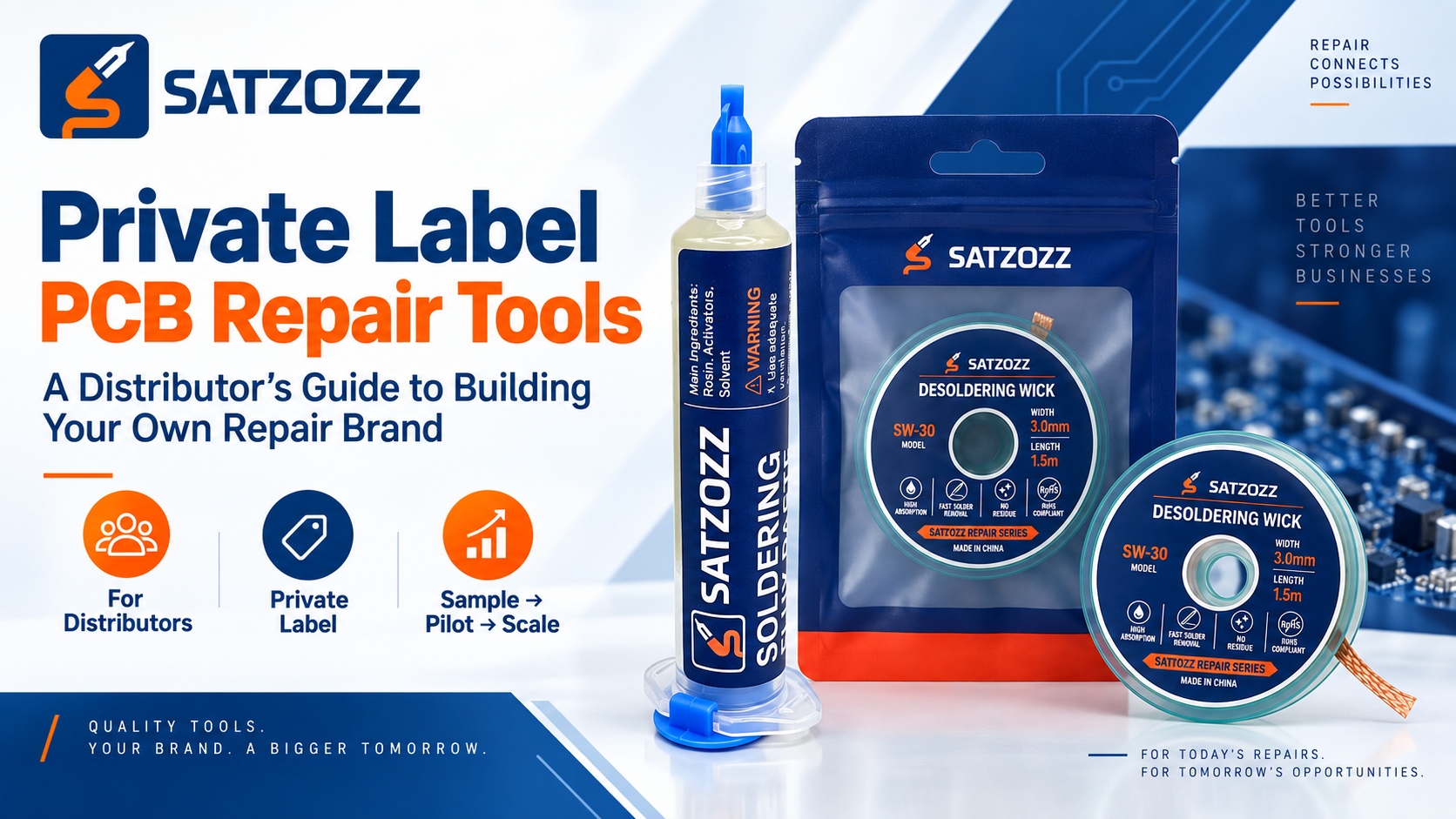
Private Label PCB Repair Tools: A Distributor’s Guide to Building Your Own Repair Brand
Private-label PCB repair tools can help distributors move beyond simple price competition, create a recognizable product range and build repeat business. The key is choosing the right products, testing them properly and starting with a controlled pilot order instead of customizing everything at once.
BUSINESS
ANSWER
For most new repair-tool brands, the safest private-label strategy is to start with a small number of proven products, test samples first, confirm packaging and labeling requirements, place a pilot order and expand only after customer feedback. Products such as soldering flux, desoldering wick and precision tweezers are logical starting categories because they fit daily PCB repair workflows and can be cross-sold together.
Many repair-tool distributors begin by reselling established brands. That is often the fastest way to enter a market.
As the business develops, however, private labeling can create something a standard resale model cannot: your own product identity.
Instead of competing only on the same SKU and the same public brand, a distributor can build a repair-tool range around its own customer base, packaging style and sales channel.
When Does Private Label Make Sense for a Repair-Tool Distributor?
Private labeling is useful when you already understand who buys from you and why.
You Already Have Repeat Customers
Repair shops and technicians repeatedly purchase the same consumables from your store or distribution business.
You Want More Brand Control
You want customers to remember your product range rather than only the original supplier.
You Want to Build a Category
You plan to sell a coordinated PCB repair range instead of isolated single products.
Which PCB Repair Tools Are Suitable for a Private-Label Starter Range?
Start with products that technicians understand and use repeatedly.
Soldering Flux
Flux is used repeatedly during PCB soldering, SMD rework and microsoldering.
Its consumable nature can create repeat purchasing when the product performs consistently.
Read the Soldering Flux Supplier Guide →Desoldering Wick
A width-based product family allows distributors to offer several SKUs for different repair applications.
SATZOZZ currently lists five wick widths from 1.0 mm to 3.0 mm.
View SATZOZZ Desoldering Wick →Precision Tweezers
Precision tweezers complement soldering consumables and help create a broader microsoldering tool assortment.
SATZOZZ currently features S-05U as one of its core precision repair products.
View S-05U Precision Tweezers →These products can also be sold together as part of a broader PCB repair category rather than competing as unrelated SKUs. SATZOZZ currently presents NC559 flux, S-05U tweezers and desoldering wick as its core microsoldering product range.
See the SATZOZZ Products page for the current assortment.
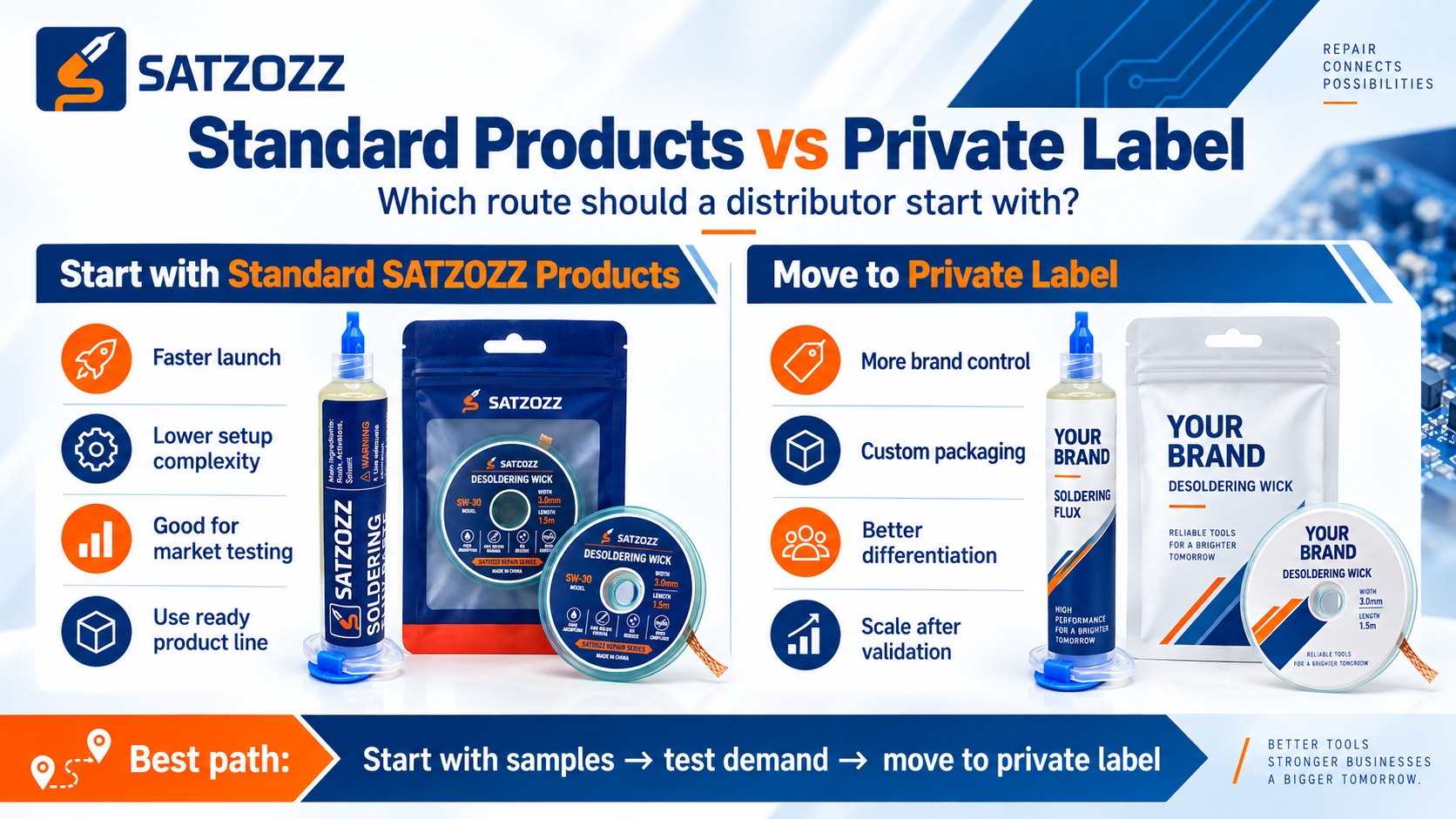
Standard SATZOZZ Products or Private Label: Which Should You Start With?
Private label is not automatically the best first order for every buyer.
Start With Standard SATZOZZ Products
Better when you want to test demand quickly without developing customized packaging first.
- Faster market testing
- Lower setup complexity
- Useful for first distributor orders
- Lets customers validate product performance first
Move to Private Label
More suitable when you already know which products and specifications sell in your market.
- Your own market identity
- More control over presentation
- Potential for a coordinated product family
- Stronger distributor brand recognition
7 Questions to Confirm Before Approving a Private-Label Project
Most private-label problems begin before production—not after it.
Which Exact Product and Specification Are You Buying?
Confirm model, dimensions, quantity, included accessories and any specifications that matter to your market before discussing artwork.
Have You Tested the Standard Product?
Do not approve custom packaging around an untested product. Have technicians evaluate samples first under real PCB repair conditions.
What Exactly Will Be Customized?
“Private label” can mean different things. Clarify whether the requirement concerns labels, retail packaging, model markings or another presentation element.
What Is the MOQ for the Requested Customization?
A standard wholesale MOQ and a customized packaging MOQ may not be the same. Confirm both before comparing quotations.
How Will Artwork Be Approved?
Confirm brand name, logo, model text, dimensions and mandatory information carefully before approving final artwork.
What Is the Production or Supply Lead Time?
Private-label buyers need to plan replenishment earlier than customers purchasing ready-stock standard products.
How Will Repeat Orders Be Controlled?
Keep a clear record of the approved product specification, packaging version and model mix so future orders can match the original commercial product.
Why Sample Testing Should Come Before Packaging Design
A good logo cannot rescue the wrong product.
Private-label buyers sometimes begin with packaging because that is the most visible part of the project.
The safer sequence is the opposite:
- Choose the product.
- Test its real repair performance.
- Confirm the target SKU.
- Then discuss packaging and branding.
SATZOZZ’s wholesale program currently emphasizes sample-order support so repair shops and distributors can test products before moving into regular wholesale orders.
Start With a Pilot Range Instead of a Large Catalog
A focused launch gives better information than a large first order.
A new distributor does not need ten or twenty private-label SKUs on day one.
A practical starter assortment might contain:
- One soldering flux product
- Two or three high-demand desoldering wick widths
- One precision tweezer model
Then use actual sales data to decide which SKUs deserve deeper inventory and additional variants.
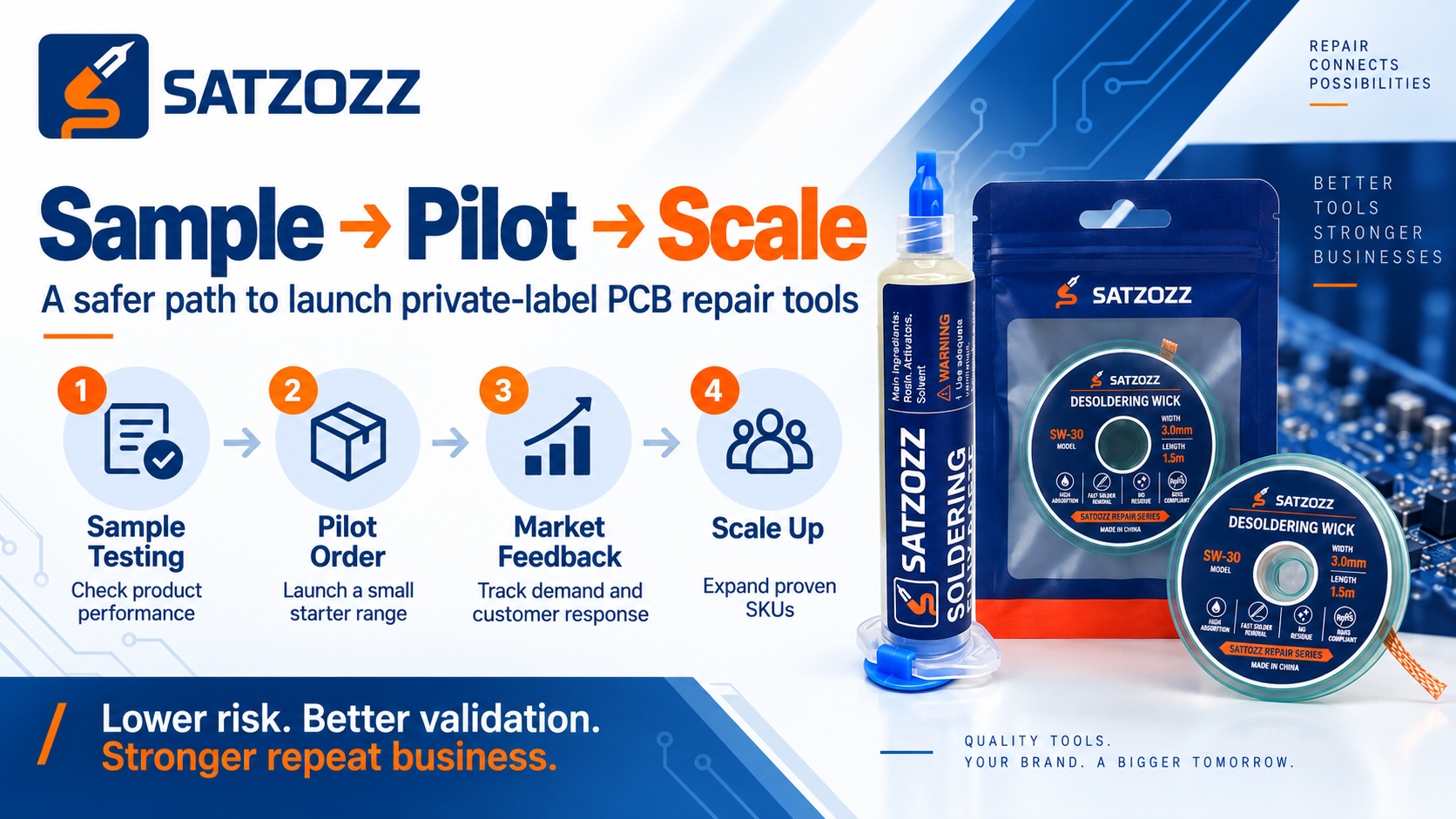
Sample
Technicians test actual products.
Pilot Order
Launch a controlled SKU range.
Market Feedback
Track sales and customer response.
Scale
Expand proven models and reorder.
What Information Should You Include in a Private-Label RFQ?
Better input produces a more useful quotation.
Avoid sending only:
Instead, tell the supplier enough to understand the project.
Example Private-Label Inquiry
We are an electronics repair tool distributor in [Country].
We are interested in building a private-label PCB repair product range for our local market.
Initial products:
• Soldering flux
• Desoldering wick
• Precision tweezers
Please advise:
• Sample availability
• Standard wholesale MOQ
• Private-label MOQ
• Packaging options
• Artwork requirements
• Estimated lead time
• Shipping terms
Estimated first order: [Quantity / SKU Mix]
Why a Complete PCB Repair Range Can Strengthen a Private Label
Product relationships matter when building a specialist brand.
A private label becomes more credible when products fit the same customer workflow.
For example:
Apply flux → remove solder → handle the component → complete the PCB repair.
This is more coherent than building a catalog from unrelated products simply because they are inexpensive.
For a broader sourcing perspective, read: How to Choose a PCB Repair Tools Supplier for Your Electronics Repair Business .
Start With Samples. Build the Range After Validation.
SATZOZZ currently works with repair-tool distributors, phone repair shops, bulk buyers and resellers, and supports sample testing before regular wholesale cooperation. Private-label requirements for selected microsoldering products should be confirmed according to the specific product, packaging and quantity requested.
Private Label PCB Repair Tools Questions
Common questions from distributors and repair-tool resellers.
What are private label PCB repair tools?
They are PCB repair products supplied for sale under a distributor’s or reseller’s own brand presentation, subject to the supplier’s available customization options.
Should I test samples before starting a private-label project?
Yes. Product performance should be approved before investing in customized packaging or larger inventory.
Which PCB repair products are suitable for a private-label starter range?
Common candidates include soldering flux, desoldering wick and precision tweezers because they fit everyday soldering, solder-removal and component-handling workflows.
Is private label the same as OEM?
Not necessarily. Private label often focuses on selling an existing or selected product under customized branding or packaging, while OEM can involve broader product-level customization. Exact capabilities should always be confirmed with the supplier.
Should a new distributor start with standard products or private label?
If market demand is not yet proven, starting with standard products and sample testing can reduce risk. Private labeling becomes more attractive once the buyer understands which SKUs sell consistently.
Does SATZOZZ support private-label cooperation?
SATZOZZ currently states that private-label cooperation is available for selected microsoldering products. Specific packaging, quantity and customization requirements should be confirmed with the sales team.
What should I include in a private-label inquiry?
Include your country, sales channel, required products, estimated quantity, target packaging, sample requirements and the specific branding elements you want customized.
Planning Your Own PCB Repair Tool Brand?
Start by validating the products first. Tell SATZOZZ your market, product requirements and estimated order quantity to discuss samples, wholesale supply and available private-label options.
Pingback: How to Plan Your First PCB Repair Tools Wholesale Order: Quantity, SKU Mix & Reorder Strategy - SATZOZZ Precision Microsoldering Tools
Pingback: How to Build a PCB Repair Tools Reorder Strategy: Sell-Through, Safety Stock & Lead Time - SATZOZZ Precision Microsoldering Tools
Pingback: How to Bundle PCB Repair Tools for Higher Order Value: Flux + Wick + Tweezers - SATZOZZ Precision Microsoldering Tools
Pingback: PCB Repair Tool Packaging for Distributors: Retail-Ready, Private Label & SKU Clarity - SATZOZZ Precision Microsoldering Tools