
How to Choose the Right Desoldering Wick Width for PCB Repair
Choosing the correct desoldering wick width improves solder absorption, reduces heating time and helps protect delicate PCB pads during repair and rework.
Quick answer: Choose a desoldering wick that is approximately the same width as the solder joint or PCB pad being cleaned. Narrow wick is suitable for fine-pitch components and small pads, while wider wick works better for large pads, through-holes and heavier solder deposits.
Desoldering wick, also called solder wick or desoldering braid, is one of the most useful consumables for electronics repair. It removes molten solder by drawing it into a braided copper structure through capillary action.
However, the result depends heavily on choosing the correct braid width. A wick that is too narrow may absorb solder slowly and require excessive heating. A wick that is too wide may transfer too much heat to nearby pads or components.
This guide explains how to select the right desoldering wick size for PCB pads, solder bridges, component removal, through-hole repair and general electronics maintenance.
Why Does Desoldering Wick Width Matter?
Faster Solder Absorption
When the copper braid covers the solder joint correctly, heat and molten solder are distributed across the appropriate surface area. This allows solder to flow into the braid more efficiently.
Reduced Heating Time
The correct wick width minimizes the time the soldering iron must remain on the board, helping reduce the risk of lifted pads, damaged solder masks and overheated components.
Cleaner PCB Pads
Properly matched braid can remove solder across the full pad surface, creating a flatter and cleaner area for component replacement or rework.
Better Control
Narrow wick gives technicians more control around fine-pitch ICs, while wider braid provides greater absorption capacity for large solder joints.
Desoldering Wick Width Selection Chart
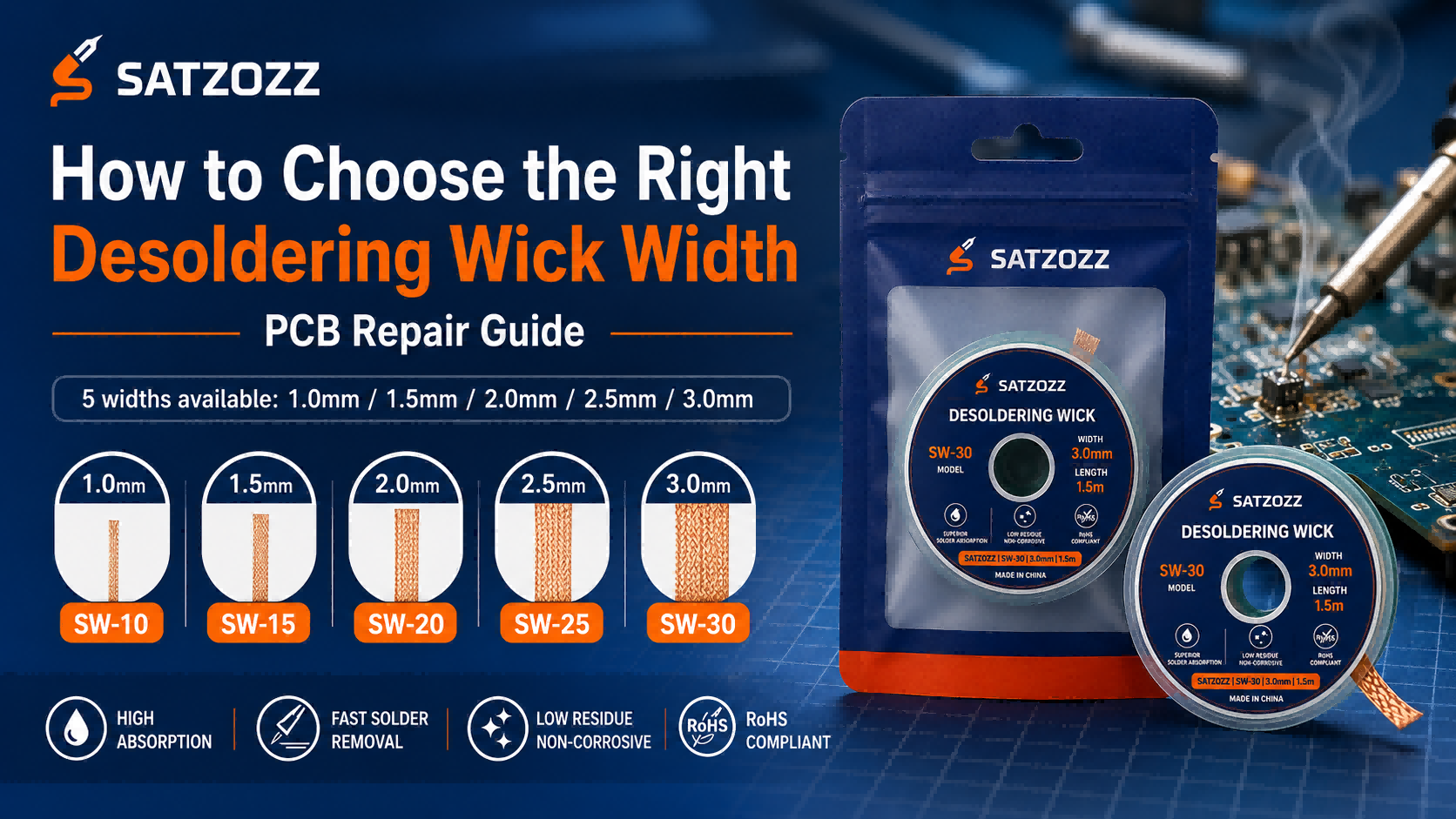
SATZOZZ Desoldering Wick is available in five widths from 1.0 mm to 3.0 mm. Each roll contains 1.5 meters of braided copper wick and is supplied in an individual resealable retail pouch.
| Model | Width | Recommended Use | Typical Applications |
|---|---|---|---|
| SW-10 | 1.0 mm | Very small solder joints and precision work | Fine-pitch IC pins, small SMD pads and compact mobile-device boards |
| SW-15 | 1.5 mm | Small PCB pads and light solder deposits | SMD components, narrow solder bridges and small connector pins |
| SW-20 | 2.0 mm | General-purpose PCB repair | Common SMD pads, IC rework, connector repair and everyday maintenance |
| SW-25 | 2.5 mm | Medium-sized pads and larger solder joints | Through-hole components, larger terminals and moderate solder removal |
| SW-30 | 3.0 mm | Large pads and heavier solder deposits | Power terminals, large through-holes, shielding points and broad PCB pads |
Which Desoldering Wick Width Should You Use?
1.0 mm Wick for Fine-Pitch PCB Work
The 1.0 mm SW-10 model is designed for precise solder removal in confined areas. It is useful when working around closely spaced pins, small surface-mount components and miniature PCB pads.
Because the braid is narrow, it allows the technician to apply heat only to the target area. This is particularly helpful on smartphone motherboards, compact control boards and other densely populated electronics.
1.5 mm Wick for Small Pads and Solder Bridges
The 1.5 mm SW-15 model provides slightly more solder absorption while still offering good control. It is suitable for small connector pins, narrow solder bridges and many common surface-mount repair tasks.
This width is often selected when 1.0 mm braid is too narrow but a general-purpose 2.0 mm wick would cover too much of the surrounding PCB area.
2.0 mm Wick for General PCB Repair
The 2.0 mm SW-20 model is the most versatile option for everyday electronics repair. It provides a useful balance between control and solder absorption capacity.
Repair technicians can use it for cleaning component pads, removing excess solder, correcting solder bridges and preparing PCB surfaces before installing replacement components.
2.5 mm Wick for Medium-Sized Solder Joints
The 2.5 mm SW-25 model is suitable for medium-sized pads, through-hole solder joints and larger connector terminals. Its wider braid absorbs a greater volume of solder during each heating cycle.
It can also be useful when removing solder from component leads that have accumulated more solder than typical surface-mount joints.
3.0 mm Wick for Large Pads and Heavy Solder
The 3.0 mm SW-30 model is intended for larger solder joints, power terminals, shielding points and broad PCB pads. Its greater width provides higher absorption capacity for heavier solder deposits.
Wider braid normally requires a soldering iron with sufficient thermal capacity. The iron must heat both the braid and the solder joint quickly enough to allow effective capillary absorption.
How to Match Wick Width to a PCB Pad
Before selecting a desoldering braid, visually compare the wick with the pad or solder joint.
- Use narrow wick when the joint is surrounded by small or closely spaced components.
- Use a width close to the pad width for general solder removal.
- Use wider braid when the joint contains a large volume of solder.
- Avoid allowing the braid to contact unrelated pads during heating.
- Use a soldering tip that provides sufficient contact with the selected braid width.
For example, a 1.0 mm wick may be appropriate for a narrow IC pad, while a 2.5 mm or 3.0 mm wick may be more effective on a large through-hole terminal.
How to Use Desoldering Wick Correctly
Position the Wick
Place a clean section of copper braid directly over the solder joint or PCB pad that needs to be cleaned.
Apply the Soldering Iron
Place the heated soldering iron tip on top of the braid. Ensure the tip makes sufficient contact to transfer heat through the copper wick.
Allow the Solder to Flow
As the solder melts, it will be drawn into the braided copper structure. Move the wick slightly only when necessary to expose a fresh absorption area.
Lift and Trim
Lift the soldering iron and braid away from the board together. Allow the braid to cool, then cut off the solder-filled section before the next use.
Common Desoldering Wick Selection Mistakes
Using Wick That Is Too Narrow
Narrow wick may not absorb enough solder from a large joint. The technician may need repeated heating cycles, increasing the risk of overheating the PCB pad.
Using Wick That Is Too Wide
Excessively wide braid can spread heat beyond the intended repair area. It may also be difficult to position around fine-pitch components or small pads.
Using an Iron Tip That Is Too Small
A very small iron tip may not transfer enough heat through a wide copper braid. Match the tip size and thermal capacity to the wick and solder joint.
Reusing a Solder-Filled Section
Once an area of braid becomes saturated with solder, it loses absorption efficiency. Trim the used section and continue with clean wick.
Applying Heat for Too Long
Desoldering should be completed with controlled heating. Prolonged contact can damage pads, laminate material or nearby components.
What Is the Best All-Purpose Desoldering Wick Size?
For general electronics repair, a 2.0 mm desoldering wick is often the most versatile choice. It is wide enough to absorb solder efficiently from many common PCB pads while remaining manageable around standard surface-mount components.
Professional repair shops often keep several widths available because no single size is ideal for every PCB. A mixed set containing 1.0 mm, 1.5 mm, 2.0 mm, 2.5 mm and 3.0 mm wick gives technicians greater flexibility.
Choosing Desoldering Wick for Different Repair Tasks
| Repair Task | Suggested Width | Reason |
|---|---|---|
| Fine-pitch IC pad cleaning | 1.0–1.5 mm | Provides precise heat and solder control |
| Small solder bridge removal | 1.0–1.5 mm | Helps avoid contact with adjacent pins |
| General SMD component repair | 1.5–2.0 mm | Balances control and absorption capacity |
| Connector and through-hole repair | 2.0–2.5 mm | Suitable for larger joints and solder volume |
| Power terminals and large pads | 2.5–3.0 mm | Provides greater solder absorption area |
Frequently Asked Questions
Should desoldering wick be wider than the solder joint?
The wick should normally be close to the width of the solder joint or pad. It can be slightly wider for large solder deposits, but it should not cover nearby components or unrelated pads.
What size solder wick is best for PCB repair?
A 2.0 mm wick is a practical general-purpose option, but precision repairs may require 1.0 or 1.5 mm braid, while large terminals may require 2.5 or 3.0 mm wick.
Can I use 3.0 mm desoldering wick on small SMD pads?
It is generally better to use narrower wick on small SMD pads. A 3.0 mm braid may transfer heat to a larger area than necessary and can be difficult to control around closely spaced components.
Why is the solder not flowing into the wick?
Common causes include insufficient heat, poor contact between the iron and braid, an oxidized soldering tip, saturated wick or choosing braid that is too wide for the iron’s thermal capacity.
Can desoldering wick be reused?
Unused braid remaining on the roll can continue to be used, but the section already filled with solder should be cut off before the next repair.
What widths are available for SATZOZZ Desoldering Wick?
SATZOZZ offers SW-10 at 1.0 mm, SW-15 at 1.5 mm, SW-20 at 2.0 mm, SW-25 at 2.5 mm and SW-30 at 3.0 mm. Each roll contains 1.5 meters of braid.
Choose the Right SATZOZZ Desoldering Wick
SATZOZZ Desoldering Wick is designed for PCB repair, component desoldering, solder bridge removal and electronics maintenance. Five available widths make it easier to match the braid to different pad sizes and solder volumes.
- Five widths from 1.0 mm to 3.0 mm
- 1.5 meters per roll
- Braided copper wick construction
- Individual resealable retail pouch
- Single-model and mixed-set options
- OEM and private-label cooperation available
Need Desoldering Wick for Repair, Wholesale or Private Label?
View the complete SATZOZZ Desoldering Wick range or contact our team for wholesale, distributor and OEM inquiries.
View Desoldering Wick Contact SATZOZZ