
How to Price PCB Repair Tools for Resale: Margin, Markup, Freight & Bundle Strategy
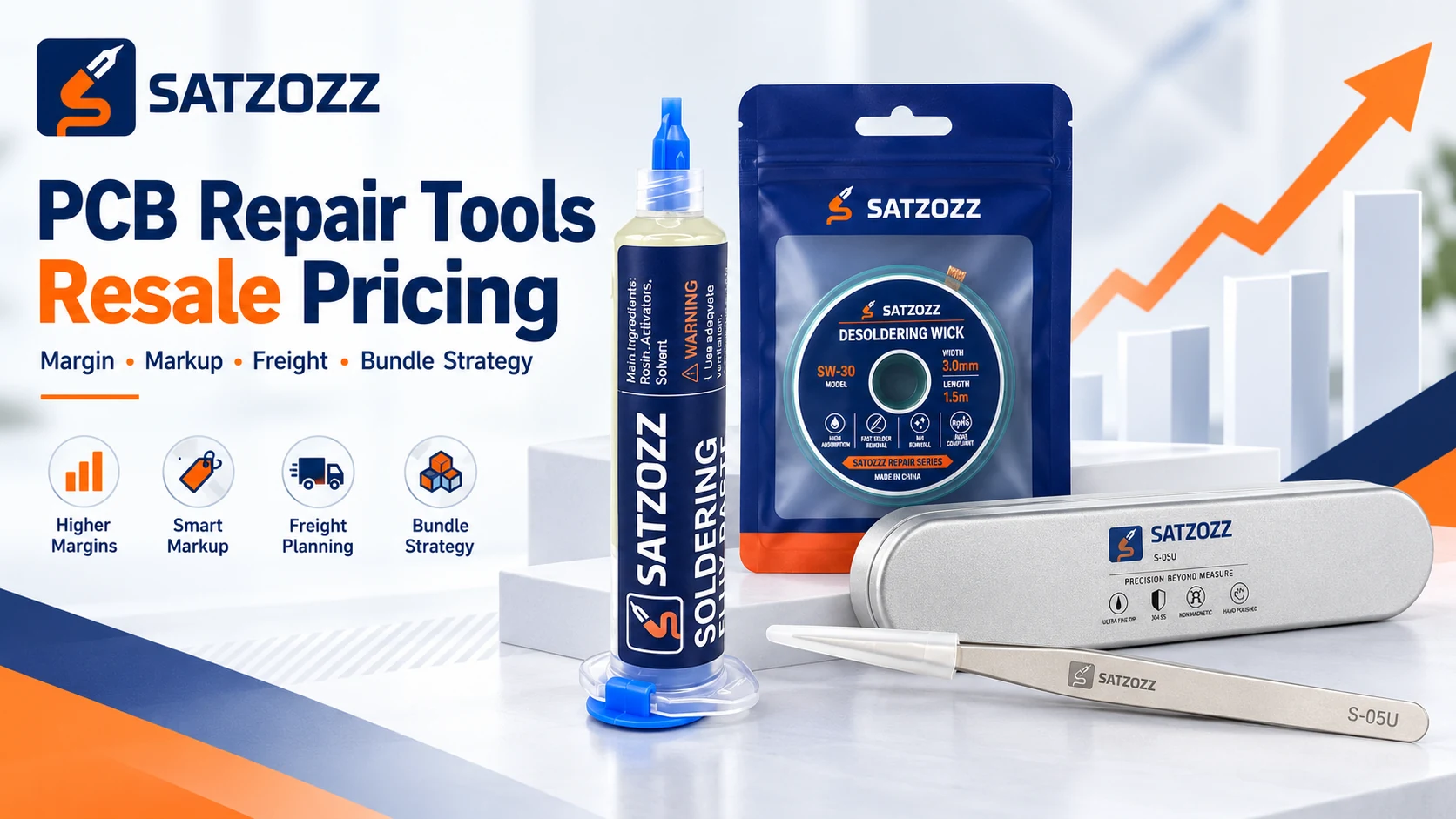
Wholesale cost is only the starting point of a resale price. Distributors also need to consider freight, packaging, marketplace fees, payment costs, promotion and inventory risk. A practical pricing model protects margin while keeping PCB repair tools competitive in the target market.
RULE
Do not calculate resale price from wholesale unit cost alone. First estimate landed cost, then add channel-specific expenses and choose a target gross margin that fits your market. Review the price again after real sales data shows return rates, advertising cost and reorder frequency.
Start With Landed Cost, Not Supplier Price
The amount on the quotation is only one part of your cost.
The supplier’s unit cost.
Your share of international or local shipping cost.
Retail packaging, relabeling or private-label costs.
Import, payment, handling and channel costs where applicable.
Basic Landed Cost Formula
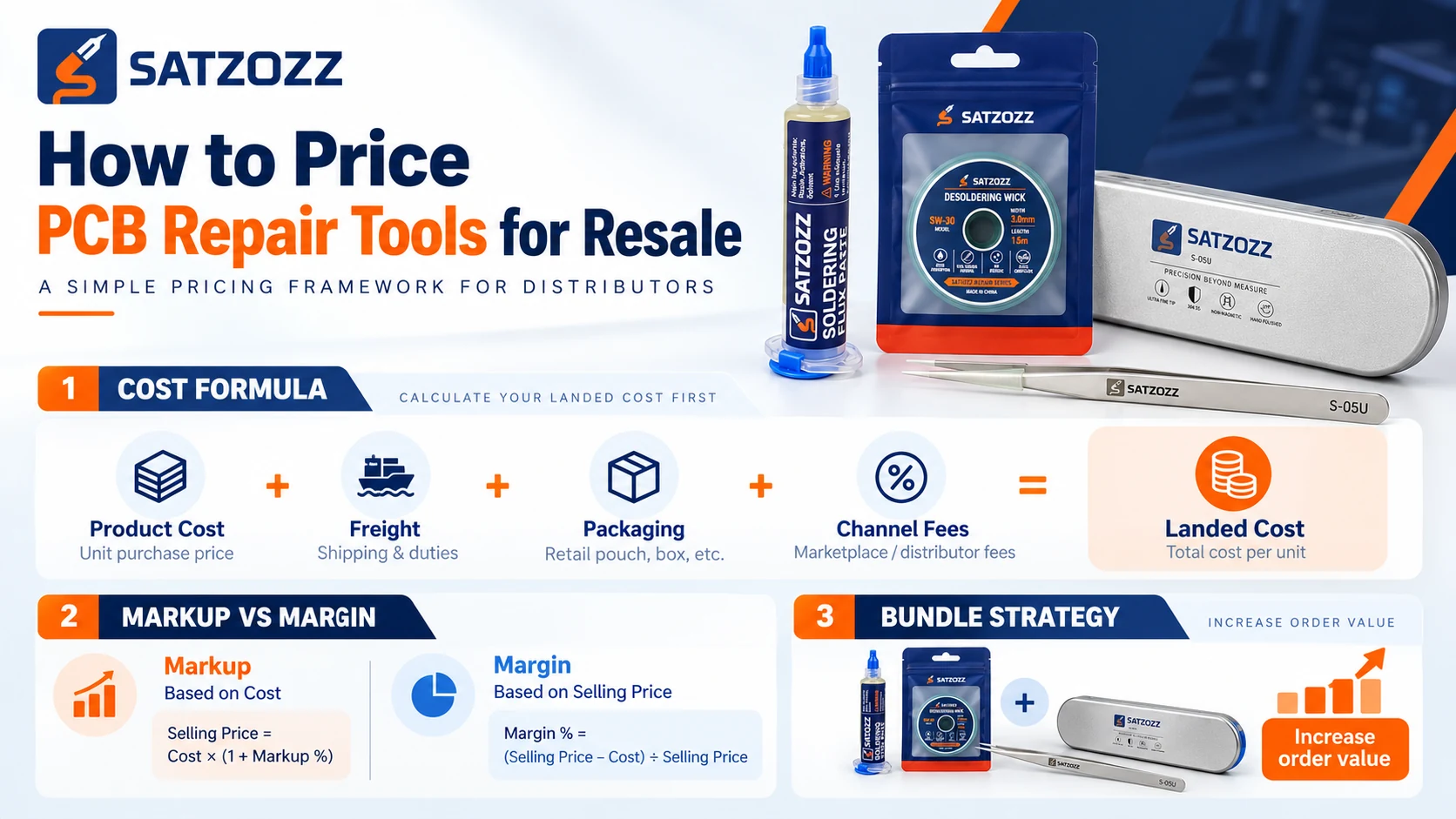
Landed Cost per Unit = Product Cost + Allocated Freight + Packaging + Applicable Purchasing Costs
The exact cost structure depends on your country, shipping method and sales channel.
If you are still deciding which repair products to stock, read: PCB Repair Tools Wholesale: What Should Distributors Stock First?
Margin and Markup Are Not the Same
Confusing the two can cause pricing errors.
Markup Is Based on Cost
Markup compares gross profit with the cost of the product.
Margin Is Based on Selling Price
Gross margin compares gross profit with the selling price.
Include Sales-Channel Costs Before Setting the Price
The same product may require different pricing in different channels.
Local Repair Store
Costs may include local staff, store overhead and distributor handling.
Ecommerce Store
Include payment fees, fulfillment, shipping support and customer-service costs.
Marketplace
Marketplace commissions, advertising and promotion can reduce the real margin significantly.
Do Not Use One Margin Target for Every PCB Repair Tool
Different product types play different roles in the catalog.
| Product Type | Commercial Role | Pricing Consideration |
|---|---|---|
| Soldering Flux | Repeat-use consumable | Competitive pricing can support repeat purchasing and repair-shop reorders. |
| Desoldering Wick | Consumable with multiple widths | Consider single-roll, multi-roll and mixed-width pricing. |
| Precision Tweezers | Reusable precision tool | Precision, tip protection and packaging can support stronger value positioning. |
| Repair Bundle | Cross-sell solution | Price the complete solution, not only the sum of individual SKUs. |
Use Multiple Price Levels Instead of One Price
A simple pricing ladder can support different customer types.
| Price Level | Typical Customer | Purpose |
|---|---|---|
| Retail Price | Individual technicians | Standard single-unit sale |
| Multi-Pack Price | Frequent users / repair shops | Encourages larger basket size |
| Trade Price | Professional repair shops | Supports recurring B2B customers |
| Distributor Price | Resellers | Leaves room for downstream resale margin |
If you are deciding which SKUs deserve deeper inventory, see: How to Build a PCB Repair Tools Reorder Strategy .
Use Bundles to Increase Value Without Only Cutting Price
Discounting is not the only way to create a stronger offer.
PCB repair products naturally support cross-selling.
Examples include:
- Flux + desoldering wick
- Flux + two wick widths
- Flux + wick + precision tweezers
- Mixed-width desoldering wick set
A bundle can create value through:
- Convenience
- Better product selection
- Higher order value
- Reduced per-order fulfillment cost
For desoldering-wick sizing and product positioning, see: Desoldering Wick for PCB Repair: How to Choose and Use Solder Removal Braid .
Private Label Can Change the Pricing Position
Your own brand changes how customers compare the product.
Standard products are often compared directly against similar listings from competing sellers.
Private-label products can give distributors more control over:
- Packaging
- Brand identity
- Product naming
- Bundle structure
- Market positioning
However, private label also introduces additional costs and should normally follow proven product demand.
Read: Private Label PCB Repair Tools: A Distributor’s Guide .
Review Pricing After Real Sales Begin
Your first pricing model is an estimate; sales data makes it better.
Launch
Use a planned starting price.
Measure
Track revenue and real channel costs.
Compare
Review margin by SKU.
Adjust
Improve price, bundle or inventory mix.
Useful metrics include:
- Gross margin by SKU
- Average order value
- Marketplace fee percentage
- Advertising cost per order
- Repeat-purchase rate
- Return or refund cost
Avoid These Common Distributor Pricing Mistakes
Small calculation errors can become large problems at scale.
A Simple Resale Pricing Checklist
Use the same process for every new PCB repair product.
| Step | Question |
|---|---|
| 1. Product Cost | What is the confirmed wholesale cost? |
| 2. Landed Cost | What does one sellable unit really cost after freight and other purchasing costs? |
| 3. Channel Cost | What fees apply to the intended sales channel? |
| 4. Margin Target | What gross margin is sustainable for this SKU? |
| 5. Market Check | Does the price make sense compared with alternatives? |
| 6. Bundle Option | Can related products increase customer value? |
| 7. Review | What do actual sales and repeat purchases show? |
Build Your Pricing Model Around Real Product Costs
SATZOZZ focuses on practical microsoldering and PCB repair tools for technicians, repair shops, distributors and resellers. Current product categories include soldering flux, desoldering wick and precision tweezers.
PCB Repair Tools Resale Pricing Questions
Common pricing questions from distributors and resellers.
How should I calculate the resale price of PCB repair tools?
Start with landed cost, add channel-related expenses and then choose a target gross margin appropriate for the product and market.
What is the difference between margin and markup?
Markup measures gross profit relative to cost, while gross margin measures gross profit relative to the selling price.
Should every PCB repair tool use the same margin?
No. Consumables, precision tools, bundles and promotional products can play different commercial roles.
Should marketplace fees be included in pricing?
Yes. Marketplace commission, payment fees, advertising and fulfillment costs can materially reduce the actual profit from a sale.
Can bundles improve distributor profitability?
Bundles can improve average order value and cross-selling when they solve a useful customer need without excessive discounting.
Can private label support stronger resale positioning?
Private label can reduce direct product comparison and give distributors more control over branding, packaging and bundle structure, although it also introduces additional costs and inventory considerations.
Need Wholesale Pricing for Your PCB Repair Tool Range?
Tell SATZOZZ your market, required products and estimated order quantity. Use the wholesale quotation as the starting point for your landed-cost and resale-pricing calculation.