
How to Test PCB Repair Tool Samples Before a Wholesale Order
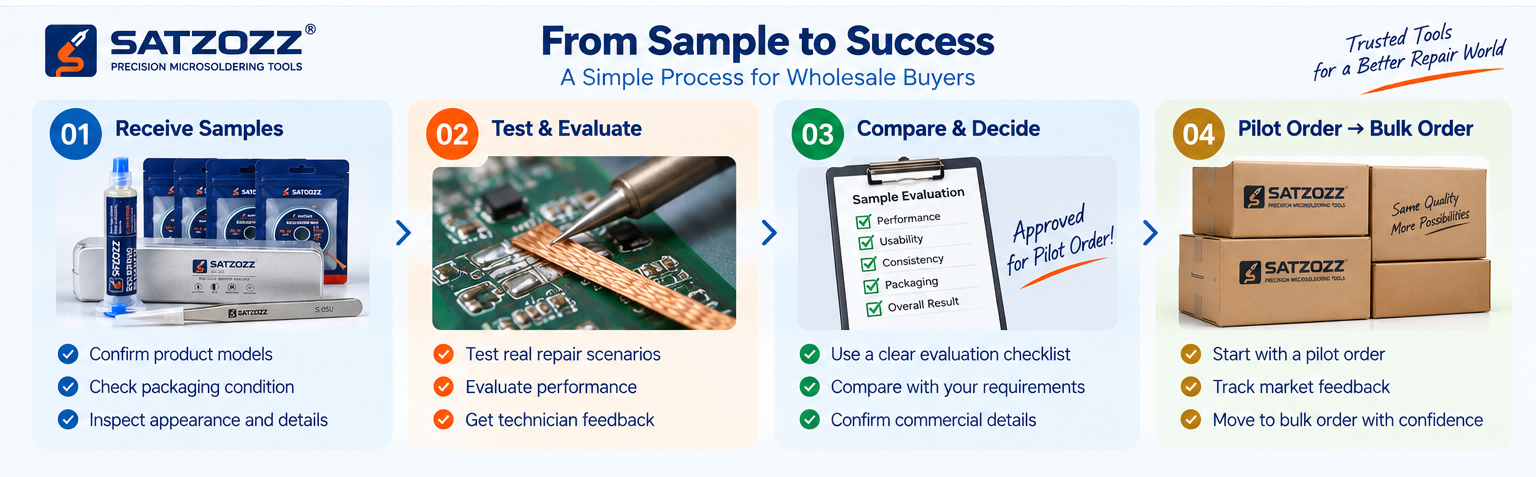
Samples should do more than confirm that a product exists. For distributors and repair-tool resellers, sample testing is the point where product performance, packaging, usability and commercial suitability can be checked before larger inventory is approved.

RULE
Do not approve PCB repair tools only by looking at product photos or testing one quick task. Give samples to technicians, test several real repair scenarios, inspect packaging, record problems and compare the results against the needs of your customers before deciding whether to place a pilot or bulk order.
What Is the Purpose of Sample Testing?
A sample is a purchasing tool, not a free promotional item.
Wholesale buyers often request samples before purchasing repair tools in larger quantities.
The objective should be to answer three questions:
Does It Work?
Test the product under normal PCB repair conditions rather than only inspecting appearance.
Will Technicians Accept It?
Let actual repair users comment on handling, consistency and practical usability.
Can You Sell It Repeatedly?
Consider packaging, SKU clarity, customer use cases and repeat-order potential.
How to Test a Soldering Flux Sample
Evaluate application behavior, soldering performance and residue.
Flux
Test Across More Than One Repair Scenario
One successful solder joint is not enough to approve a sample.
Avoid evaluating flux using excessive temperature or excessive product quantity because poor technique can distort the result.
Related guide: How to Choose a Soldering Flux Supplier .
How to Test a Desoldering Wick Sample
The test should include both solder absorption and handling control.
Wick
Match the Wick to the Repair Area
A braid can appear poor simply because the wrong width is being tested.
SATZOZZ Desoldering Wick currently covers five widths from 1.0 mm to 3.0 mm, allowing buyers to test fine, general and larger solder-removal applications.
For troubleshooting, see: Why Is My Desoldering Wick Not Absorbing Solder? .
For width selection, see: How to Choose the Right Desoldering Wick Width .
How to Test Precision Tweezers
Precision tools should be evaluated for repeatability, not only appearance.
Tweezers
Test With the Components Your Customers Actually Handle
Real component handling reveals more than visual inspection.
SATZOZZ currently lists S-05U as a core precision tweezer for PCB repair and microsoldering.
View: SATZOZZ S-05U Precision Tweezers .
Do Not Forget to Test the Packaging
Product quality and resale quality are separate issues.
A technician may care mainly about how the tool performs. A distributor must also care about what arrives at the customer.
Use a Simple Sample Evaluation Scorecard
A written record makes supplier comparisons much more useful.
| Test Area | What to Check | Suggested Weight |
|---|---|---|
| Product Performance | Does the tool perform its intended repair function consistently? | 30% |
| Technician Usability | Is the product easy to handle during real work? | 20% |
| Consistency | Do repeated tests produce similar results? | 20% |
| Packaging | Is the sample protected, identifiable and resale-ready? | 15% |
| Commercial Fit | Does the product suit your customers and sales channel? | 15% |
Keep a Record of Every Approved Sample
Sample approval should create a reference for future purchasing.
This becomes especially useful when you later discuss private-label packaging or reorder the same model.
Related: Private Label PCB Repair Tools .
Sample Approved: Should You Go Straight to a Bulk Order?
For a new market, a pilot order is usually more informative.
Sample
Confirm product performance.
Pilot Order
Test the product in your real sales channel.
Market Feedback
Measure sales and customer response.
Bulk Order
Increase proven SKUs.
This staged approach reduces the risk of placing deep inventory into a product that technicians like during testing but customers do not actually purchase in your market.
For assortment planning, read: PCB Repair Tools Wholesale: What Should Distributors Stock First? .
Questions to Send the Supplier After Sample Testing
Once the technical test is complete, move to commercial confirmation.
- Is the sample specification the same as the regular wholesale product?
- What is the current wholesale MOQ?
- Can different models or wick widths be mixed?
- What is the lead time for the pilot order?
- What packaging will be used?
- Is the approved product normally available for repeat orders?
- Which products can support private-label cooperation later?
- What information is needed for a formal quotation?
For a wider supplier evaluation framework, see: How to Choose a PCB Repair Tools Supplier .
Test Before You Build Inventory
SATZOZZ currently supports sample testing for repair-tool distributors, repair shops and resellers. Core wholesale products include NC559 No-Clean Flux, S-05U Precision Tweezers and SATZOZZ Desoldering Wick.
PCB Repair Tool Sample Testing Questions
Common questions from wholesale buyers and distributors.
Why should distributors test samples before ordering PCB repair tools?
Sample testing helps confirm product performance, technician usability, packaging and commercial suitability before the buyer commits to larger inventory.
Who should test PCB repair tool samples?
Ideally, both purchasing staff and actual repair technicians should be involved. Technicians evaluate practical use, while buyers evaluate packaging and commercial fit.
How many times should a sample be tested?
Avoid approving a product after one successful use. Repeat the test across several representative repair tasks to check consistency.
What should I test in a soldering flux sample?
Check dispensing control, solder wetting, behavior under normal soldering or rework conditions and residue after heating.
What should I test in desoldering wick?
Evaluate solder absorption, heat transfer, width suitability and handling using a fresh section of braid on realistic PCB joints.
Should I place a bulk order immediately after approving samples?
For a new market, a pilot order can provide valuable sales data before deeper inventory is purchased.
Does SATZOZZ provide samples for wholesale buyers?
SATZOZZ currently supports sample orders for distributors, repair shops, resellers and other wholesale buyers.
Want to Test SATZOZZ Before a Wholesale Order?
Tell us which products you are interested in, your market and your expected order quantity. Start with samples, evaluate the products and then build a wholesale range around proven demand.