
No-Clean Flux vs Rosin Flux: Which Is Better for PCB Repair?
Compare no-clean and rosin flux for microsoldering, PCB rework, SMD repair, desoldering and electronics maintenance.
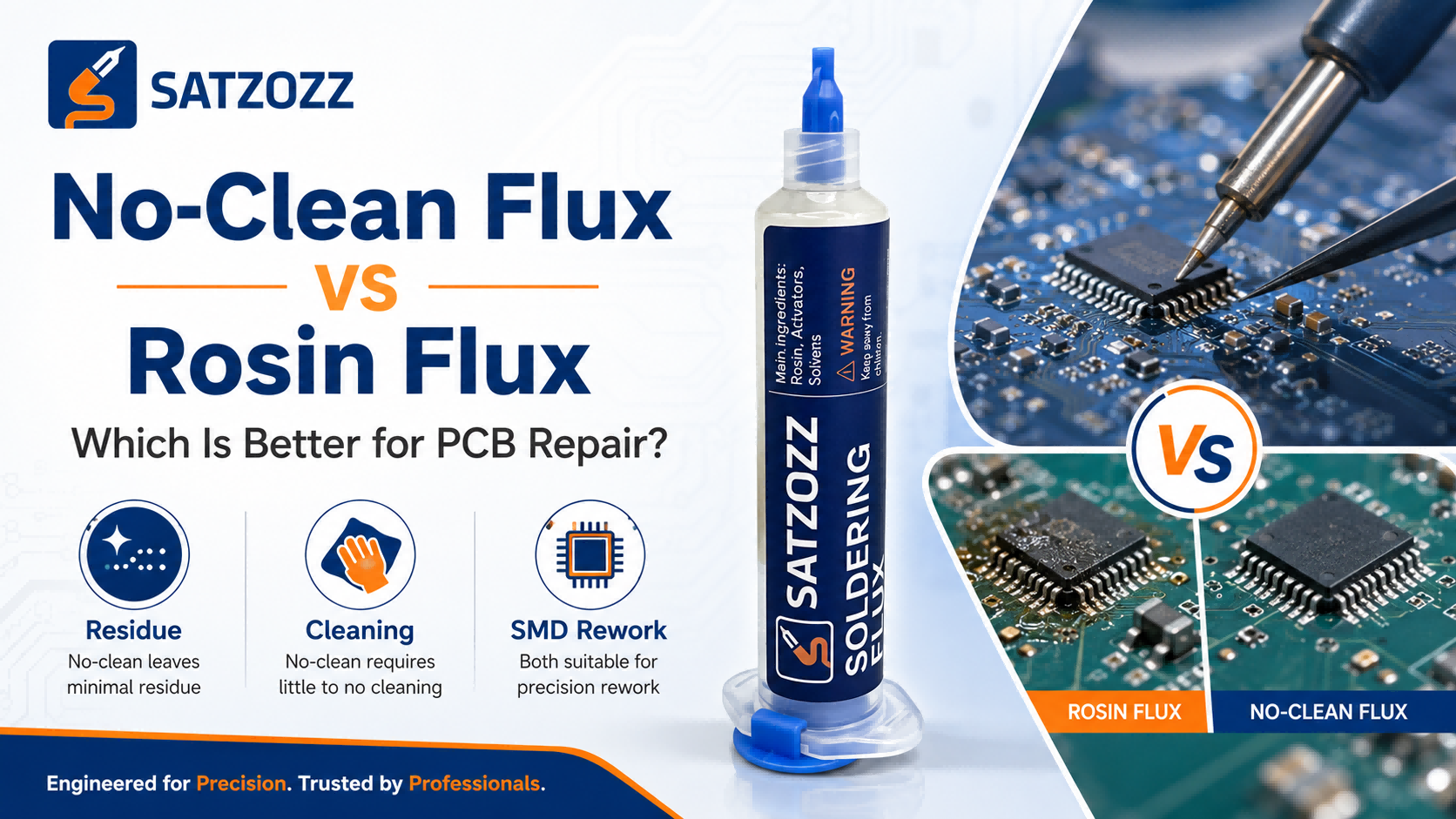
Quick answer: No-clean flux is often preferred for precision PCB repair when low residue and reduced post-repair cleaning are priorities. Rosin flux can provide reliable soldering performance and is widely used for electronics work, but its residue may be more visible and may require cleaning depending on the formulation, repair process and circuit requirements.
Flux plays a critical role in PCB soldering and rework. It removes surface oxidation, improves solder wetting and helps molten solder flow across copper pads, component leads and soldering tools.
Two commonly discussed options are no-clean flux and rosin flux. Both can support reliable electronics soldering, but they differ in residue characteristics, activity level, cleaning requirements and suitable applications.
Choosing the correct flux is especially important in microsoldering, where technicians work around fine-pitch components, small pads and densely populated circuit boards.
Choose No-Clean Flux When
- You want minimal visible residue.
- The repair area is difficult to clean.
- You are working on small SMD components.
- You need controlled flux application.
- Post-repair appearance matters.
- The assembly permits no-clean residue.
Choose Rosin Flux When
- You need dependable general-purpose wetting.
- The board can be cleaned after repair.
- Visible residue is acceptable temporarily.
- You are performing traditional electronics soldering.
- The selected rosin formulation matches the job.
No-Clean Flux vs Rosin Flux at a Glance
| Comparison | No-Clean Flux | Rosin Flux |
|---|---|---|
| Primary purpose | Support soldering with limited residue | Provide reliable wetting for electronics soldering |
| Residue appearance | Usually lighter or less visible | May leave more visible amber or brown residue |
| Cleaning requirement | May not require cleaning in approved applications | Often cleaned when appearance or reliability requires it |
| Fine-pitch repair | Well suited to controlled microsoldering | Can work well, depending on activity and residue |
| General electronics repair | Suitable | Suitable |
| Visual inspection | Cleaner appearance when used correctly | Residue may need removal before inspection |
| Desoldering wick use | Useful for controlled PCB rework | Can improve wetting and solder absorption |
| Cleaning process | Depends on residue and assembly requirements | Depends on formulation and manufacturer instructions |
What Is No-Clean Flux?
No-clean flux is formulated so that the residue left after soldering can remain on certain electronic assemblies without mandatory cleaning, provided that the flux is used correctly and the assembly requirements permit it.
It is commonly used in PCB rework because technicians can apply a controlled amount to a small repair area without creating a large amount of heavy residue.
Advantages of No-Clean Flux
- Usually leaves less visible residue.
- Can reduce post-repair cleaning time.
- Suitable for precise application around SMD parts.
- Useful for microsoldering and localized PCB rework.
- Can support clean visual presentation.
Limitations of No-Clean Flux
- “No-clean” does not mean residue is always harmless.
- Excess application may still leave sticky residue.
- Some residues can interfere with inspection or testing.
- Highly oxidized joints may need stronger flux activity.
- Cleaning may still be required on sensitive assemblies.
What Is Rosin Flux?
Rosin flux is traditionally based on rosin-derived materials and is widely used in electronics soldering. When heated, it helps reduce surface oxides and promotes solder wetting.
Rosin flux is available in different activity levels and formulations. The exact cleaning requirement depends on the specific product, residue condition and assembly requirements.
Advantages of Rosin Flux
- Provides reliable wetting for many electronics repairs.
- Widely used for traditional PCB soldering.
- Available in multiple activity levels.
- Can help with oxidized solder joints.
- Suitable for component replacement and rework.
Limitations of Rosin Flux
- May leave visible amber or brown residue.
- Residue can make inspection more difficult.
- Cleaning may be required after repair.
- Excess flux can spread under nearby components.
- Different formulations have different residue properties.
Does No-Clean Flux Really Require No Cleaning?
Not necessarily. The term “no-clean” means the residue may be designed to remain on approved assemblies when the flux is applied and processed correctly.
Cleaning may still be appropriate when:
- Too much flux was applied.
- Residue surrounds fine-pitch pins.
- The PCB requires close visual inspection.
- The circuit has high-impedance or sensitive areas.
- The customer requires a visibly clean board.
- The residue traps dust or other contamination.
- The flux manufacturer recommends cleaning.
Which Flux Is Better for SMD and Fine-Pitch Repair?
No-clean flux is often selected for SMD and fine-pitch rework because it can be applied in small controlled amounts and typically leaves less visible residue.
This is useful around:
- Fine-pitch IC leads
- Small SMD pads
- Smartphone motherboards
- Laptop logic boards
- Compact control boards
- Connector pins and flexible circuits
Rosin flux can also perform well, but the technician must consider residue, cleaning access and the activity level of the selected formulation.
Recommended Choice for Precision Microsoldering
Which Flux Is Better for Oxidized Solder Joints?
Heavily oxidized solder joints require enough flux activity to remove surface oxides and restore wetting.
Some rosin flux formulations may provide stronger activity than mild no-clean products. However, flux performance depends on the exact formulation rather than the product name alone.
Recommended Approach for Oxidation
Which Flux Is Better for Lead-Free Solder?
Lead-free solder often requires more heat and may be less forgiving than some traditional tin-lead alloys. Good flux performance helps improve wetting and reduce prolonged heating.
Both no-clean and rosin-based products can be used with lead-free solder when their formulation is designed for that process.
Check:
- The recommended solder alloy
- The flux activation temperature
- The working temperature range
- The residue classification
- The cleaning instructions
- The intended electronics application
Which Flux Is Better With Desoldering Wick?
Desoldering wick depends on good solder wetting. A small amount of suitable flux can help molten solder enter the braided copper more efficiently.
No-clean flux is often convenient for localized PCB repair because it can improve wetting without creating a large amount of visible residue.
Rosin flux can also improve wick performance, especially when the solder joint is dull or oxidized. The board may require more cleaning afterward.
| Desoldering Condition | Suggested Flux Approach | Reason |
|---|---|---|
| Clean, fresh solder joint | Extra flux may be optional | The solder may already wet the braid efficiently |
| Fine-pitch PCB pad | Controlled no-clean flux | Supports precise application and limited residue |
| Old or oxidized joint | Suitable activated electronics flux | Helps reduce oxidation and improve solder flow |
| Residue-sensitive repair | Minimal no-clean flux | Reduces unnecessary residue when permitted |
| Board will be cleaned afterward | No-clean or rosin flux | Choice can focus more on activity and process needs |
Read: Do You Need Flux When Using Desoldering Wick?
No-Clean Flux vs Rosin Flux for Common PCB Repair Tasks
| Repair Task | Suggested Option | Reason |
|---|---|---|
| Fine-pitch IC rework | No-clean flux | Supports precise application with limited visible residue |
| General component replacement | No-clean or rosin flux | Both may work when matched to the soldering process |
| Oxidized solder joints | Flux with suitable activity | Activity level matters more than the category name |
| PCB that cannot be cleaned easily | No-clean flux | Reduces post-repair cleaning requirements when permitted |
| Repair followed by full cleaning | No-clean or rosin flux | Residue can be removed after soldering |
| Desoldering wick on SMD pads | Controlled no-clean flux | Helps improve wetting with localized application |
| Traditional electronics soldering | Rosin flux | Widely used for general electronics work |
How to Choose Between No-Clean and Rosin Flux
Check the PCB and Component Type
Fine-pitch and densely populated boards generally benefit from controlled, localized flux application.
Evaluate the Solder Joint Condition
New and clean joints may need mild flux, while oxidized joints may require higher activity.
Decide Whether the Board Can Be Cleaned
When cleaning is difficult, a suitable no-clean formulation may be more practical.
Check the Solder Alloy
Confirm that the flux supports the working temperature and alloy used in the repair.
Consider Residue Requirements
Visual inspection, electrical sensitivity and customer requirements may determine whether residue must be removed.
Read the Manufacturer Instructions
Follow the application, storage, cleaning and safety guidance provided for the exact flux formulation.
Common Flux Selection Mistakes
Assuming All No-Clean Flux Is the Same
No-clean products can differ in viscosity, activity, residue and working temperature. Select the formulation based on the repair process.
Assuming Rosin Residue Never Needs Cleaning
Cleaning requirements depend on the exact rosin formulation, residue condition and assembly requirements.
Using Too Much Flux
Excess flux can spread under components, generate additional fumes and make inspection more difficult.
Using Plumbing or Acid Flux
Acid-based plumbing flux is not suitable for PCB repair. Corrosive residue can damage pads, traces and component leads.
Ignoring Storage Conditions
Heat, contamination and improper sealing can affect flux consistency and performance. Store flux according to the manufacturer’s instructions.
Flux Safety and Handling
- Work in a ventilated area or use suitable fume extraction.
- Avoid direct skin and eye contact.
- Do not breathe soldering fumes.
- Keep flux containers closed when not in use.
- Follow the product safety data and handling instructions.
- Keep flux away from children and food preparation areas.
- Use only electronics-grade flux for circuit-board work.
Frequently Asked Questions
Is no-clean flux better than rosin flux?
No-clean flux is often better when low residue and reduced cleaning are priorities. Rosin flux may be suitable when reliable general-purpose wetting is needed and the board can be cleaned afterward.
Does no-clean flux really need no cleaning?
Not always. No-clean residue may remain on approved assemblies when applied correctly, but cleaning can still be required for inspection, sensitive circuitry or excessive residue.
Is rosin flux safe for electronics?
Electronics-grade rosin flux is commonly used for soldering and PCB rework. Follow the manufacturer’s application and cleaning instructions.
Which flux is better for SMD soldering?
A controlled no-clean flux is often convenient for SMD and fine-pitch soldering because it can leave less visible residue. The exact formulation must still match the repair process.
Which flux is better for desoldering wick?
Both can improve solder absorption. No-clean flux is convenient for localized repairs, while a suitable rosin flux can help with oxidized joints.
Can I mix no-clean and rosin flux?
Mixing different flux formulations is generally not recommended unless the manufacturers confirm compatibility. Mixed residues can complicate cleaning and process control.
Can I leave rosin flux residue on a PCB?
That depends on the exact formulation, residue condition and circuit requirements. Clean the board when recommended by the manufacturer or required by the application.
Can I use plumbing flux for electronics?
No. Plumbing flux may contain corrosive materials and should not be used on electronic circuit boards.
Choose the Right Flux for Precision PCB Repair
No-clean and rosin flux can both support reliable PCB soldering when the exact formulation matches the solder alloy, oxidation level, repair method and cleaning requirements.
SATZOZZ provides microsoldering tools for PCB repair, including NC559 No-Clean Flux, precision tweezers and desoldering wick in multiple widths.
- Suitable for precision soldering and PCB rework
- Controlled syringe application
- Designed for microsoldering workflows
- Pairs with desoldering wick and precision tweezers
- Wholesale and private-label cooperation available
Need No-Clean Flux for PCB Repair?
Explore SATZOZZ microsoldering products or contact our team for wholesale, distributor and private-label inquiries.
View SATZOZZ Products Contact SATZOZZ