
Does Soldering Flux Expire? Shelf Life, Storage and Signs It Has Gone Bad
Learn how age, temperature, air exposure and contamination affect soldering flux, how to identify degraded flux and how to store tacky and liquid flux correctly.
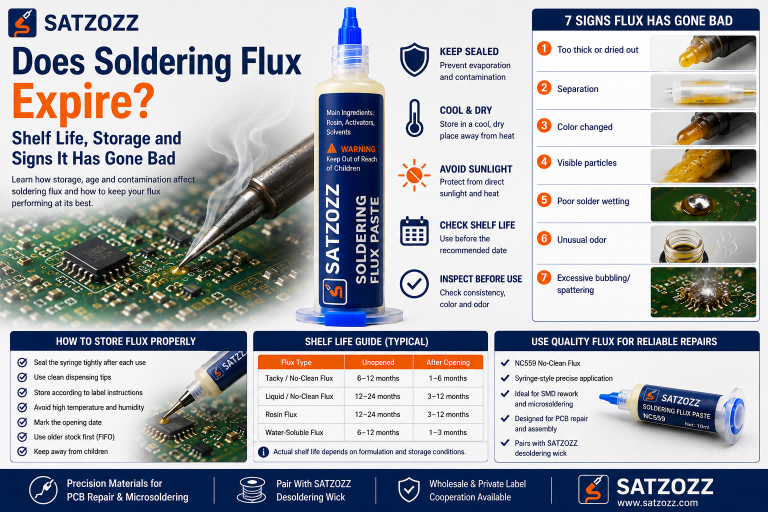
Quick answer: Yes, soldering flux can degrade over time. Its solvents, activators and viscosity can change during storage, especially when the container is repeatedly opened or exposed to heat, air, moisture or contamination. Always follow the shelf-life and storage information supplied with the specific flux. Replace flux when its consistency, odor, color or soldering performance changes significantly.
Soldering flux is a formulated chemical material rather than a product that remains unchanged indefinitely.
Over time, volatile ingredients can evaporate, solvents can change concentration and contamination can enter the container. Tacky flux may become unusually thick or separated, while liquid flux may evaporate or change in activity.
However, age alone does not tell you everything. A correctly stored flux may perform normally near the end of its specified shelf life, while a poorly stored product can deteriorate much earlier.
How Can You Tell If Soldering Flux Is Still Good?
Likely Normal
- Consistency matches the original product.
- No visible contamination is present.
- The flux dispenses smoothly.
- Solder wets normally.
- Residue behavior remains consistent.
Inspect Before Use
- Flux appears thicker than usual.
- Some separation is visible.
- Dispensing becomes inconsistent.
- Flux spreads differently than before.
- Storage history is unknown.
Consider Replacing
- Foreign particles are visible.
- Color changed dramatically.
- Flux has dried or crystallized.
- Odor changed unexpectedly.
- Solder wetting is consistently poor.
What Happens to Flux as It Gets Older?
Solvent Loss
Volatile ingredients can slowly escape when a container is opened repeatedly or not sealed correctly.
Tacky flux may become thicker, while liquid flux may become more concentrated.
Viscosity Changes
Changes in solvent concentration or prolonged storage can alter the way flux flows and dispenses.
Contamination
Used needles, dirty brushes or open containers can introduce solder particles, dust, metal oxides or other contaminants.
Activity Changes
Flux performance may decline if the chemical balance of the formulation changes during improper storage.
7 Signs Your Soldering Flux May Have Gone Bad
1. The Flux Has Become Much Thicker
Tacky flux naturally has a gel-like consistency, but a major increase in viscosity can indicate solvent loss.
You may notice that the syringe requires much more force or that the flux no longer forms a smooth controlled bead.
2. The Flux Has Separated
Some formulations can show minor changes during storage, but severe phase separation can indicate that the product is no longer uniform.
3. The Color Has Changed Significantly
A small color difference can occur between formulations or production batches, but strong darkening or unexpected cloudiness should be investigated.
4. The Flux Contains Visible Particles
Foreign particles can come from dirty dispensing tips, solder debris, dust or poor handling.
Contaminated flux should not be applied to fine-pitch PCB assemblies.
5. The Flux Does Not Wet Solder Properly
One of the clearest practical signs of a problem is a consistent decline in solder wetting despite correct temperature, clean metal surfaces and a properly maintained soldering tip.
6. The Flux Produces Unusual Residue
Flux that suddenly leaves much heavier, darker or more irregular residue than before may have changed during storage.
Excessive residue can also result from too much flux or incorrect heating, so process conditions should be checked first.
7. Flux Starts Bubbling or Spattering Differently
Changes in moisture, solvent content or viscosity can alter how the flux responds when heated.
If a previously stable product suddenly pops or spatters excessively, check both the storage condition and soldering process.
Does Tacky Flux Expire?
Yes. Tacky flux contains solvents, activators and resin components that can change with time and storage conditions.
Syringe-style tacky flux is particularly sensitive to contamination and solvent loss when the cap is left open or the dispensing tip is not sealed properly.
| Condition | Possible Effect | Recommended Action |
|---|---|---|
| Tip left open | Solvent loss and thicker flux | Seal immediately after use |
| Stored at excessive temperature | Accelerated formulation changes | Follow specified storage conditions |
| Dirty needle reused | Contamination enters syringe | Use clean dispensing accessories |
| Long storage after opening | Consistency may gradually change | Inspect before precision PCB work |
| Visible drying at syringe tip | Blocked or inconsistent dispensing | Replace or clean the dispensing tip as appropriate |
Does Liquid Flux Expire?
Liquid flux can also deteriorate over time. Because it contains more volatile solvent, evaporation can change its concentration when the bottle is repeatedly opened or poorly sealed.
Signs to monitor include:
- Unusual color changes
- Sediment or particles
- Different spreading behavior
- Unexpected odor
- Reduced solder wetting
- Changes in residue
Does No-Clean Flux Expire?
“No-clean” describes residue behavior and flux classification. It does not mean that the product has unlimited storage life.
No-clean flux should still be:
- Stored according to manufacturer instructions.
- Kept properly sealed.
- Protected from contamination.
- Used within the manufacturer’s specified shelf life.
- Inspected when its appearance or performance changes.
Can You Use Expired Soldering Flux?
A printed expiration or shelf-life date does not automatically tell you how badly a particular container has degraded, but using material outside the manufacturer’s specified shelf life introduces uncertainty.
This matters more in:
- Professional repair work
- Fine-pitch microsoldering
- BGA and QFN rework
- Production environments
- Customer repairs requiring repeatability
- Assemblies where residue reliability is important
For critical or commercial work, replacing questionable flux is usually more economical than troubleshooting poor solder joints caused by an uncertain consumable.
How to Store Soldering Flux Properly
Follow the Product Label or Technical Data
Storage temperature varies by formulation. Use the storage conditions specified for the exact flux.
Keep the Container Sealed
Close the syringe, bottle or cartridge immediately after use to reduce solvent evaporation and contamination.
Keep Dispensing Tips Clean
Do not allow oxidized solder, PCB debris or cleaning chemicals to enter the flux container.
Avoid Direct Sunlight and Heat
Do not leave flux beside a soldering station, hot-air tool, heater or inside a hot vehicle.
Prevent Moisture and Dust Contamination
Keep caps and dispensing components clean and dry.
Mark the Opening Date
Professional repair shops can write the first-use date on each container to improve inventory control.
Use Older Stock First
Follow a first-in, first-out inventory system rather than opening several flux syringes simultaneously.
Inspect Before Critical Repair
Check appearance, consistency and dispensing behavior before using older flux on valuable circuit boards.
Should Soldering Flux Be Refrigerated?
Some flux formulations specify refrigerated or temperature-controlled storage, while others are designed for room-temperature storage.
Therefore, do not automatically refrigerate every flux.
Always follow the specific product instructions regarding:
- Storage temperature
- Maximum storage time
- Freezing restrictions
- Room-temperature stabilization before use
- Handling after opening
Can You Freeze Soldering Flux?
Do not intentionally freeze flux unless the manufacturer specifically states that freezing is acceptable.
Freezing and repeated temperature cycling may alter consistency or cause separation in some formulations.
If a flux has accidentally frozen, check the manufacturer’s instructions before using it.
Why Is My Tacky Flux Hard to Push Out of the Syringe?
Increased dispensing force can be caused by:
- A blocked dispensing needle
- Dried flux at the outlet
- Low storage temperature
- Solvent loss
- Flux that has become unusually viscous
- An applicator opening that is too small
Do not automatically assume that the flux itself has expired. First inspect the needle and storage temperature.
Can You Add Solvent to Old Flux?
Do not add alcohol, IPA, acetone or another solvent to old flux unless the flux manufacturer specifically provides a controlled dilution or replenishment procedure.
Adding an unknown amount of solvent can change:
- Flux activity
- Viscosity
- Residue characteristics
- Activation temperature
- Solder wetting behavior
For PCB repair, replacing degraded flux is normally preferable to modifying the formulation yourself.
How Storage Problems Affect PCB Repair
| Storage Problem | Possible Soldering Result | What You May Notice |
|---|---|---|
| Solvent evaporation | Flux becomes too thick | Difficult syringe dispensing |
| Moisture contamination | Unstable heating behavior | Bubbling or spattering |
| Foreign contamination | Poor or inconsistent wetting | Particles in the repair area |
| High-temperature storage | Accelerated degradation | Color or consistency changes |
| Container left open | Solvent loss and contamination | Dry surface or clogged applicator |
| Repeated temperature cycling | Possible separation | Uneven texture or dispensing |
How Long Does Soldering Flux Last After Opening?
There is no universal after-opening period that applies to all flux.
Longevity depends on:
- The specific formulation
- Original packaging
- Storage temperature
- How often the container is opened
- Whether dispensing accessories remain clean
- Exposure to air and moisture
For professional inventory control, record the opening date and follow the manufacturer’s shelf-life guidance.
Flux Storage Mistakes to Avoid
Leaving the Syringe Uncapped
This increases solvent evaporation and contamination.
Leaving Flux Beside a Soldering Station
Continuous exposure to heat may shorten useful storage life.
Reusing Dirty Dispensing Needles
Solder and PCB contamination can be pushed back toward the container.
Opening Several Syringes at Once
Multiple partly used containers can remain open longer than necessary.
Ignoring the Storage Label
Different formulations may require different storage temperatures.
Using Old Flux on a Critical Board Without Testing
Valuable or difficult repairs are not the best place to test uncertain consumables.
Frequently Asked Questions
Does soldering flux expire?
Yes. Flux can degrade with age, solvent loss, contamination and improper storage. Follow the shelf-life information for the specific product.
How can you tell if soldering flux is bad?
Warning signs include major viscosity changes, separation, contamination, unusual color or odor and consistently poor solder wetting.
Can you use expired soldering flux?
Using flux beyond its specified shelf life adds process uncertainty. For professional or critical PCB repair, questionable material should normally be replaced.
Does no-clean flux expire?
Yes. No-clean describes residue classification, not unlimited shelf life.
Does tacky flux expire?
Yes. Tacky flux can lose solvent, become unusually thick, separate or become contaminated over time.
Should soldering flux be refrigerated?
Only when the manufacturer specifies refrigerated storage. Storage requirements vary between formulations.
Can I add IPA to dried soldering flux?
Do not add IPA or another solvent unless the manufacturer provides a specific dilution procedure. Doing so may change the flux chemistry and residue behavior.
Why is old flux difficult to push from a syringe?
The dispensing tip may be blocked, the flux may be cold, or solvent loss may have increased viscosity.
Keep Your PCB Repair Materials Clean and Controlled
Good flux performance depends not only on formulation but also on storage, dispensing and handling.
SATZOZZ NC559 No-Clean Flux uses syringe-style packaging for localized application during PCB soldering, SMD rework and microsoldering.
- Precision syringe-style application
- Designed for localized PCB rework
- Suitable for SMD and microsoldering workflows
- Pairs with SATZOZZ desoldering wick
- Wholesale and private-label cooperation available
Need Flux and Microsoldering Tools for PCB Repair?
Explore SATZOZZ flux, desoldering wick and precision tools, or contact our team for wholesale, distributor and private-label inquiries.
View SATZOZZ Products Contact SATZOZZ