
Tacky Flux vs Liquid Flux: Which Should You Use for PCB Repair?
Compare viscosity, application control, residue, cleaning and performance for SMD soldering, hot-air rework, drag soldering, desoldering and general electronics repair.
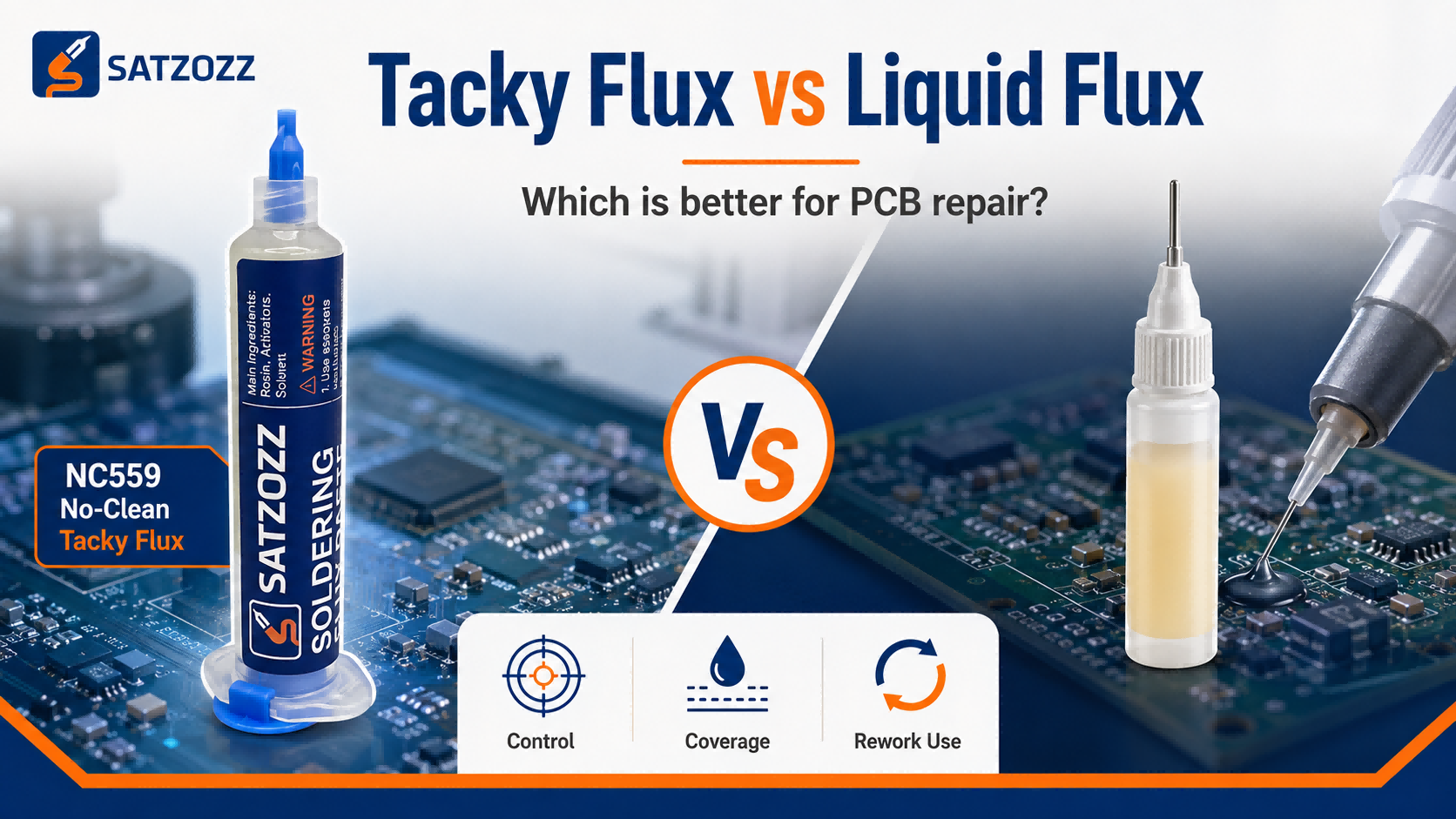
Quick answer: Tacky flux is usually better for localized SMD rework, hot-air component removal, BGA repair and microsoldering because it stays in place and can be dispensed precisely. Liquid flux is usually better for quickly covering larger pad areas, lead rows, wires and through-hole joints. Neither type is universally better—the correct choice depends on the repair method, component size, application control and cleaning requirements.
Tacky flux and liquid flux perform the same basic function: they reduce surface oxidation and help molten solder wet PCB pads, component leads and copper conductors.
Their main difference is physical consistency. Tacky flux is thick and gel-like, while liquid flux flows easily across metal surfaces.
This difference affects where the flux remains during heating, how precisely it can be applied, how much residue it leaves and which repair processes it supports most effectively.
Choose Tacky Flux For
- Precision SMD soldering
- Fine-pitch IC rework
- Hot-air component removal
- BGA and QFN rework
- Localized microsoldering
- Vertical or angled PCB surfaces
- Syringe-controlled application
Choose Liquid Flux For
- Quick pad coverage
- Through-hole soldering
- Wire and connector soldering
- Flux-pen application
- Large component lead rows
- General soldering preparation
- Areas where easy flow is useful
Tacky Flux vs Liquid Flux at a Glance
| Comparison | Tacky Flux | Liquid Flux |
|---|---|---|
| Consistency | Thick, gel-like and slow-flowing | Thin and free-flowing |
| Application control | High | Medium to high with a flux pen |
| Stays in place | Excellent | May spread beyond the target area |
| Fine-pitch repair | Excellent | Suitable when carefully applied |
| Hot-air rework | Excellent | May evaporate or flow away quickly |
| Through-hole soldering | Suitable | Very suitable |
| Large-area coverage | Slower to distribute | Fast and even |
| Residue volume | Can be heavier if over-applied | Usually thinner, depending on formulation |
| Common applicator | Syringe and fine dispensing needle | Flux pen, dropper, brush or bottle |
What Is Tacky Flux?
Tacky flux is a high-viscosity soldering flux designed to stay where it is placed. It is commonly supplied in a syringe and dispensed through a small needle or tip.
Its gel-like consistency helps prevent uncontrolled spreading across the PCB. This makes it useful for targeted repairs involving small pads, closely spaced leads and components heated with hot air.
Advantages of Tacky Flux
- Provides precise localized application.
- Stays beneath or around the target component.
- Works well during hot-air rework.
- Helps hold small components temporarily.
- Useful on vertical or angled PCB surfaces.
- Supports fine-pitch and microsoldering work.
Limitations of Tacky Flux
- Can leave heavier residue when over-applied.
- May be difficult to spread across a large area.
- Requires a syringe or controlled dispenser.
- May become thicker if stored incorrectly.
- Residue can remain beneath components.
What Is Liquid Flux?
Liquid flux has a lower viscosity and spreads quickly over copper pads, component leads and wires.
It can be applied with a flux pen, brush, dropper or precision bottle. Flux pens are especially useful for creating thin, controlled coatings without flooding the board.
Advantages of Liquid Flux
- Covers larger areas quickly.
- Flows easily around component leads.
- Works well for wires and through-hole joints.
- Can be applied in a thin layer with a flux pen.
- Useful for pad preparation and general soldering.
Limitations of Liquid Flux
- Can spread beneath unrelated components.
- May run into switches and connectors.
- Can flow away from vertical repair areas.
- May evaporate quickly during hot-air work.
- Pouring directly from a bottle provides poor control.
Which Flux Is Better for SMD Soldering?
Tacky flux is usually the more controlled option for small SMD components. It can be placed directly on the target pads and remains localized during component positioning.
Liquid flux can also work well, especially when applied with a precision flux pen. It is useful when a thin coating is required across several nearby pads.
Recommended Choice for Small SMD Components
Which Flux Is Better for Fine-Pitch IC Repair?
Fine-pitch IC work requires precise wetting without flooding adjacent components.
Tacky flux is commonly preferred because it remains along the pin row and does not run away before the soldering iron reaches the joint.
For drag soldering, a thin continuous line should be used rather than a large bead that hides solder bridges.
Recommended Choice for Fine-Pitch Leads
Which Flux Is Better for Hot-Air Rework?
Tacky flux is generally better for hot-air component removal and installation because it stays around the component while heated air moves across the PCB.
Liquid flux can spread away from the joint, evaporate quickly or enter nearby components.
Recommended Choice for Hot Air
Which Flux Is Better for BGA and QFN Rework?
Tacky flux is commonly used for BGA and QFN rework because it remains beneath the package and supports solder wetting during hot-air heating.
Its viscosity may also help keep small solder balls or the replacement component in position before reflow.
Which Flux Is Better for Through-Hole Soldering?
Liquid flux is often more convenient for through-hole leads because it flows around the component lead and annular ring.
A flux pen or small brush can provide controlled coverage without filling the entire hole or flooding the opposite side of the board.
Recommended Choice for Through-Hole Joints
Which Flux Is Better for Wires and Connectors?
Liquid flux is generally easier to apply around stranded wires, connector terminals and larger metal surfaces.
It can flow between wire strands and help solder wet the full conductor. Care is still required to prevent liquid from entering enclosed connectors, switches or cable insulation.
Which Flux Is Better With Desoldering Wick?
Both types can improve solder absorption by helping molten solder wet the copper braid.
Tacky Flux With Wick
Useful when a small amount must remain on one specific PCB pad or braid section.
Liquid Flux With Wick
Useful for quickly treating a short section of braid, but excessive liquid may spread across the PCB.
Apply only a thin layer. The wick should not be heavily saturated with flux.
Read: Do You Need Flux When Using Desoldering Wick?
Does Tacky Flux Leave More Residue?
Tacky flux can leave more visible residue because it contains a higher concentration of material in a small area and is often applied as a gel.
Residue depends on:
- The exact flux formulation
- The amount applied
- Heating temperature and time
- Whether the flux was fully activated
- The PCB cleaning process
A thin tacky-flux layer may leave less total contamination than a large quantity of uncontrolled liquid flux.
Related guide: Why Does Soldering Flux Turn Brown or Sticky?
Is Tacky Flux the Same as No-Clean Flux?
No. “Tacky” describes viscosity, while “no-clean” describes the intended residue classification.
Tacky flux can be no-clean, rosin-based or another electronics flux formulation. Liquid flux can also be no-clean or rosin-based.
Tacky Flux vs Liquid Flux for Common Repair Tasks
| Repair Task | Suggested Flux Type | Reason |
|---|---|---|
| Single SMD component | Tacky flux | Stays on the target pads |
| Fine-pitch IC leads | Tacky flux | Provides controlled coverage along the pin row |
| Hot-air component removal | Tacky flux | Remains around the component during airflow |
| BGA or QFN rework | Tacky flux | Stays beneath the package during reflow |
| Through-hole lead | Liquid flux | Flows around the lead and annular ring |
| Wire tinning | Liquid flux | Penetrates between wire strands |
| Large connector terminals | Liquid or tacky flux | Choice depends on surface angle and application control |
| Desoldering wick | Either type | Use a thin controlled layer on the contact area |
How to Choose Between Tacky and Liquid Flux
Identify the Repair Method
Hot-air and precision SMD work generally favor tacky flux, while through-hole and wire soldering often favor liquid flux.
Consider the Board Position
Tacky flux remains more stable on vertical or angled surfaces.
Evaluate Component Density
Dense PCB areas require localized application to avoid contaminating neighboring parts.
Determine the Required Coverage
Use tacky flux for a small targeted area and liquid flux for thin, broader coverage.
Check Residue and Cleaning Requirements
Confirm whether the residue can remain or must be removed after repair.
Follow the Product Instructions
Verify solder-alloy compatibility, operating temperature, storage and cleaning guidance.
How Much Tacky Flux Should You Use?
Apply enough to form a thin localized film over the target pads or leads. A large bead is rarely necessary.
- Use a fine syringe tip.
- Start with a small amount.
- Keep the flux within the heated zone.
- Add more only if wetting remains poor.
- Clean excessive or unactivated residue when required.
Read: How Much Soldering Flux Should You Use?
Common Flux Selection and Application Mistakes
Using Liquid Flux Near an Open Connector
Low-viscosity flux may flow inside the connector housing.
Applying a Large Bead of Tacky Flux
Excess gel can hide solder bridges and leave heavy residue.
Using Liquid Flux for Vertical Repair
The flux may run away before the soldering iron reaches the joint.
Assuming All Tacky Flux Is No-Clean
Viscosity does not determine residue classification.
Pouring Liquid Flux Directly Onto a PCB
This creates poor application control and unnecessary contamination.
Adding New Flux Over Burnt Residue
Old residue can interfere with wetting and inspection.
How to Store Tacky and Liquid Flux
- Follow the manufacturer’s storage temperature instructions.
- Keep containers sealed when not in use.
- Protect dispensing tips from dust and contamination.
- Do not return used flux to the original container.
- Check shelf-life information before use.
- Allow refrigerated products to stabilize as instructed.
- Keep flux away from children, food and ignition sources.
Frequently Asked Questions
Is tacky flux better than liquid flux?
Tacky flux is generally better for precision SMD and hot-air rework, while liquid flux is often better for broader pad coverage, through-hole joints and wire soldering.
What is tacky flux used for?
Tacky flux is used for fine-pitch soldering, SMD repair, hot-air rework, BGA and QFN work, and other repairs requiring localized flux.
What is liquid flux used for?
Liquid flux is used for pad preparation, through-hole soldering, wire tinning, connectors and applications requiring thin, fast coverage.
Is tacky flux the same as no-clean flux?
No. Tacky describes viscosity. No-clean describes residue classification. Tacky flux can be no-clean, rosin-based or another electronics formulation.
Which flux is better for hot-air rework?
Tacky flux is usually better because it remains around the component instead of flowing away during heating.
Which flux is better for drag soldering?
Tacky flux applied in a thin line provides reliable coverage and stays along the fine-pitch component leads.
Can liquid flux be used with desoldering wick?
Yes. Apply only a small amount to the solder joint or short section of braid to avoid spreading flux across the PCB.
Does tacky flux need to be cleaned?
Cleaning depends on the flux formulation, application amount, activation and PCB requirements. No-clean tacky flux may still require cleaning when excessive or unactivated.
Use SATZOZZ No-Clean Flux for Controlled PCB Rework
The SATZOZZ NC559 No-Clean Flux Kit uses syringe-style dispensing to support localized PCB repair, SMD soldering and microsoldering.
- Controlled syringe application
- Suitable for localized SMD rework
- Useful for soldering and desoldering workflows
- Pairs with SATZOZZ desoldering wick
- Wholesale and private-label cooperation available
Need Flux and Microsoldering Tools for PCB Repair?
Explore SATZOZZ flux, desoldering wick and precision tools, or contact our team for wholesale, distributor and private-label inquiries.
View SATZOZZ Products Contact SATZOZZ