
Desoldering Wick vs Solder Sucker: Which Is Better for PCB Repair?
When removing solder from a PCB, two common tools are often used: desoldering wick and a solder sucker. Both can help remove molten solder, but they work in different ways and are better suited for different repair jobs.
For PCB repair technicians, electronics maintenance users, and repair shops, choosing the right solder removal tool can improve repair speed, reduce board damage, and make the rework process cleaner.
In this guide, we compare desoldering wick vs solder sucker, explain when to use each tool, and show why SATZOZZ Desoldering Wick is a practical choice for PCB pad cleaning, solder bridge removal, and daily electronics repair work.
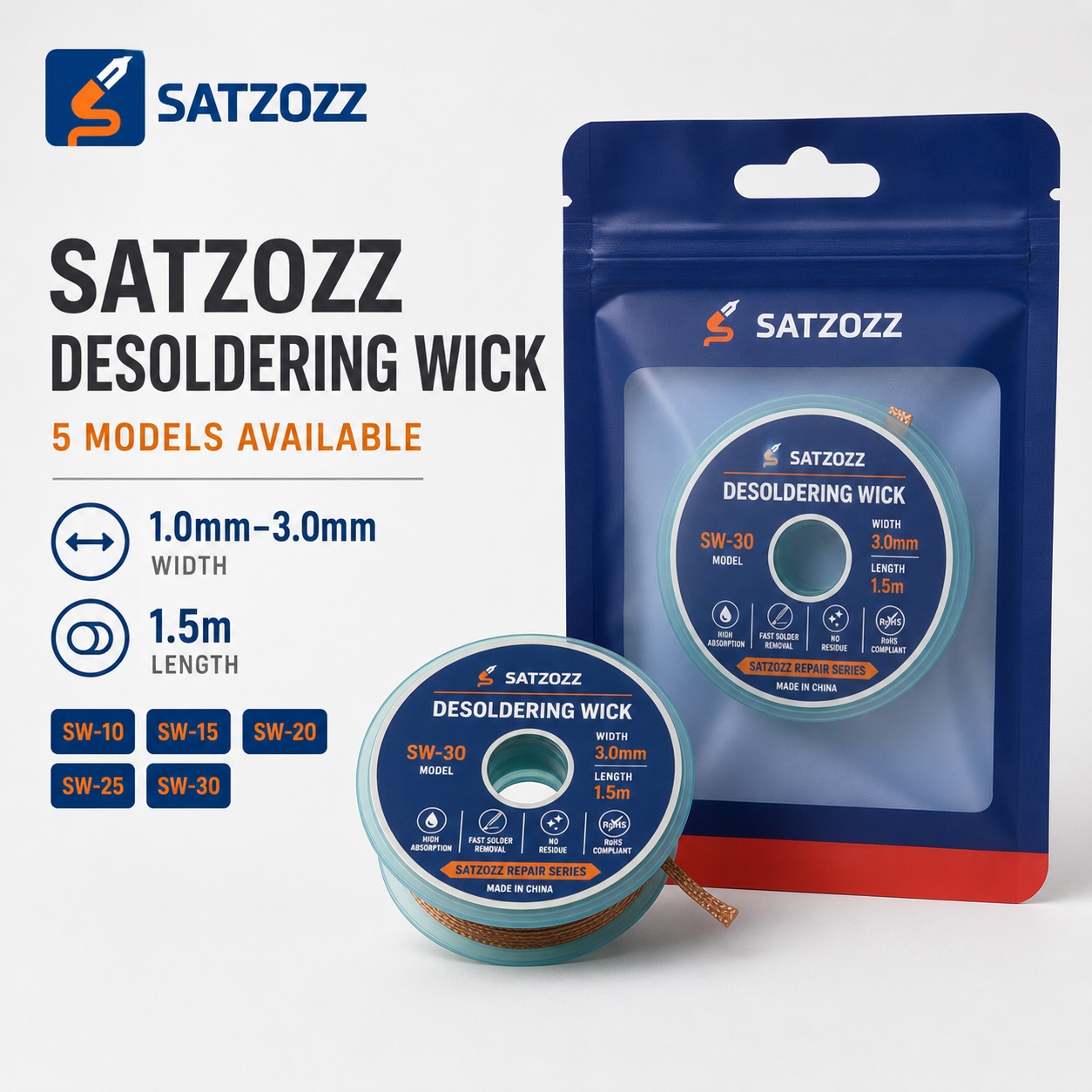
SATZOZZ Desoldering Wick is available in SW-10, SW-15, SW-20, SW-25 and SW-30 widths for different PCB repair and solder removal tasks.
Quick answer: A solder sucker is better for removing larger amounts of molten solder from through-hole joints, while desoldering wick is better for cleaning PCB pads, removing solder bridges, and performing controlled solder removal in detailed repair work. For fine PCB repair, desoldering wick usually gives better precision.
People Also Ask About Desoldering Wick vs Solder Sucker
Is desoldering wick better than a solder sucker?
Desoldering wick is better for cleaning pads, removing solder bridges, and working on fine PCB repair areas. A solder sucker is better for removing a larger volume of solder from through-hole joints. The better choice depends on the repair task.
When should I use desoldering wick?
Use desoldering wick when you need controlled solder removal, clean PCB pads, solder bridge removal, or fine repair work around small components. It is especially useful for SMD repair and detailed electronics rework.
When should I use a solder sucker?
Use a solder sucker when you need to remove a larger amount of solder quickly, especially from through-hole component leads. It works well when there is enough molten solder for suction to remove.
Can desoldering wick remove solder bridges?
Yes. Desoldering wick is one of the most practical tools for solder bridge removal. Place the wick over the bridge, heat it with a soldering iron, and let the braided copper absorb the excess solder.
Do repair technicians need both tools?
In many repair shops, technicians use both tools. A solder sucker can remove bulk solder first, and desoldering wick can clean the remaining solder from pads or bridges. Using both tools together often gives better repair results.
What Is Desoldering Wick?
Desoldering wick, also called solder removal braid, desoldering braid, or solder wick, is a braided copper wire used to absorb molten solder from PCB pads, component leads, and solder bridges.
When the wick is placed on a solder joint and heated with a soldering iron, the molten solder moves into the copper braid through capillary action. This makes desoldering wick especially useful for controlled and precise solder removal.
SATZOZZ Desoldering Wick is designed for PCB repair, electronics maintenance, solder bridge removal, and component rework. It is available in 1.0mm, 1.5mm, 2.0mm, 2.5mm and 3.0mm widths.
What Is a Solder Sucker?
A solder sucker is a suction tool used to remove molten solder. It usually has a spring-loaded or vacuum mechanism. After the solder is melted with a soldering iron, the solder sucker pulls the molten solder away from the joint.
Solder suckers are often used for through-hole components, connector pins, and larger solder joints. They are useful when there is enough solder volume for suction to remove efficiently.
Desoldering Wick vs Solder Sucker: Key Differences
| Comparison | Desoldering Wick | Solder Sucker |
|---|---|---|
| Working Method | Absorbs molten solder into braided copper | Removes molten solder through suction |
| Best For | PCB pad cleaning, solder bridge removal, fine repair | Through-hole joints and larger solder volume |
| Precision | High precision and better control | Less precise, better for bulk removal |
| Repair Cleanliness | Leaves pads cleaner for inspection and rework | May leave remaining solder that needs cleanup |
| Learning Curve | Easy to use with proper heat control | Easy to use but requires timing and positioning |
| Common Use | SMD repair, bridge removal, pad cleaning | Through-hole desoldering and large joints |
When Desoldering Wick Is the Better Choice
Desoldering wick is usually the better option when you need precision and control. It is especially useful in PCB repair work where the repair area is small, delicate, or close to other components.
Best for Pad Cleaning
After removing a component, desoldering wick can clean the remaining solder from PCB pads. This helps prepare the board for a new component or further inspection.
Best for Solder Bridge Removal
If solder accidentally connects two pins or pads, desoldering wick can absorb the excess solder and separate the bridge cleanly.
Best for Fine PCB Repair
Narrow wick sizes such as 1.0mm or 1.5mm are suitable for small pads, SMD repair, and delicate electronics work.
Best for Final Cleanup
Even after using a solder sucker, desoldering wick is often used to clean the remaining solder and make the repair area smoother.
When a Solder Sucker Is the Better Choice
A solder sucker is more useful when you need to remove a larger amount of solder quickly. It is commonly used for through-hole components, connector pins, and larger solder joints.
For example, if you are removing a through-hole capacitor, switch, or connector, a solder sucker can remove most of the molten solder quickly. After that, desoldering wick can be used to clean any remaining solder from the pad.
Which Tool Should Repair Shops Choose?
For professional PCB repair and electronics maintenance, the best answer is usually not one or the other. Many repair shops keep both tools on the workbench.
A practical workflow is:
- Use a solder sucker to remove bulk solder from large or through-hole joints.
- Use desoldering wick to clean the remaining solder from PCB pads.
- Use narrow desoldering wick for solder bridge removal and detailed rework.
- Inspect the pad before applying new solder or replacing components.
This combination gives technicians both speed and precision.
How to Choose the Right Desoldering Wick Width
Choosing the correct wick width helps improve repair efficiency and reduces unnecessary heat exposure. SATZOZZ offers five widths for different tasks:
| Model | Width | Length | Recommended Use |
|---|---|---|---|
| SW-10 | 1.0mm | 1.5m | Ultra-fine work, small pads and delicate repair |
| SW-15 | 1.5mm | 1.5m | Fine SMD repair and small solder joints |
| SW-20 | 2.0mm | 1.5m | General PCB repair and electronics maintenance |
| SW-25 | 2.5mm | 1.5m | Medium solder joints and larger pads |
| SW-30 | 3.0mm | 1.5m | Large solder joints and stronger solder removal |
View all available widths on the SATZOZZ Desoldering Wick product page.
Common Mistakes When Using Desoldering Wick
1. Using a Wick That Is Too Wide
If the wick is too wide for a small pad, it may transfer too much heat to the surrounding area. For fine SMD repair, choose a narrower wick.
2. Dragging the Wick Across the PCB
Do not scrape or drag the wick aggressively. Place it on the solder area, apply heat, and let it absorb the solder naturally.
3. Using Too Much Heat for Too Long
Excessive heat can damage pads or components. Use proper heat control and remove the wick once the solder is absorbed.
4. Reusing the Same Used Section
Once the braid has absorbed solder, cut off the used part and continue with a clean section for better absorption.
Recommended Tool: SATZOZZ Desoldering Wick
SATZOZZ Desoldering Wick is designed for PCB repair, electronics maintenance, solder bridge removal, and component rework. It offers multiple width options for different repair tasks and comes in retail pouch packaging suitable for repair shops, online sellers, and wholesale buyers.
It is especially useful for:
- PCB pad cleaning after component removal
- Solder bridge removal
- Electronics maintenance and rework
- Repair shop daily solder removal tasks
- Wholesale repair tool supply
Need Desoldering Wick for PCB Repair?
Explore SATZOZZ Desoldering Wick for solder bridge removal, PCB pad cleaning, electronics maintenance and professional repair work.
View SATZOZZ Desoldering Wick →FAQ
Is desoldering wick better than a solder sucker?
Desoldering wick is better for precision work, pad cleaning and solder bridge removal. A solder sucker is better for quickly removing larger amounts of solder from through-hole joints.
Can I use desoldering wick after using a solder sucker?
Yes. This is a common repair workflow. A solder sucker can remove most of the solder first, and desoldering wick can clean the remaining solder from the PCB pad.
What desoldering wick size should I use for PCB repair?
For small pads and SMD repair, use 1.0mm or 1.5mm wick. For general PCB repair, 2.0mm is practical. For larger joints, use 2.5mm or 3.0mm.
Can desoldering wick damage a PCB?
Desoldering wick can damage a PCB if too much heat or pressure is applied. Use proper temperature control, avoid dragging the wick, and remove it once the solder is absorbed.
Is desoldering wick good for solder bridge removal?
Yes. Desoldering wick is one of the most effective tools for removing solder bridges because it absorbs excess solder with good control.
Conclusion
In the comparison of desoldering wick vs solder sucker, neither tool completely replaces the other. A solder sucker is useful for removing larger amounts of solder, while desoldering wick is better for precise cleanup, solder bridge removal, and PCB pad cleaning.
For repair shops, technicians, and electronics maintenance users, the best setup is often to use both tools together. If your repair work involves PCB pads, solder bridges, SMD repair, or final cleanup, SATZOZZ Desoldering Wick is a practical solder removal braid to keep on the workbench.