
Anti-Magnetic vs Regular Precision Tweezers
Does reduced magnetic attraction actually matter for PCB repair? Learn when anti-magnetic tweezers offer a practical advantage, when regular precision tweezers are sufficient, and why anti-magnetic and ESD-safe are not the same specification.
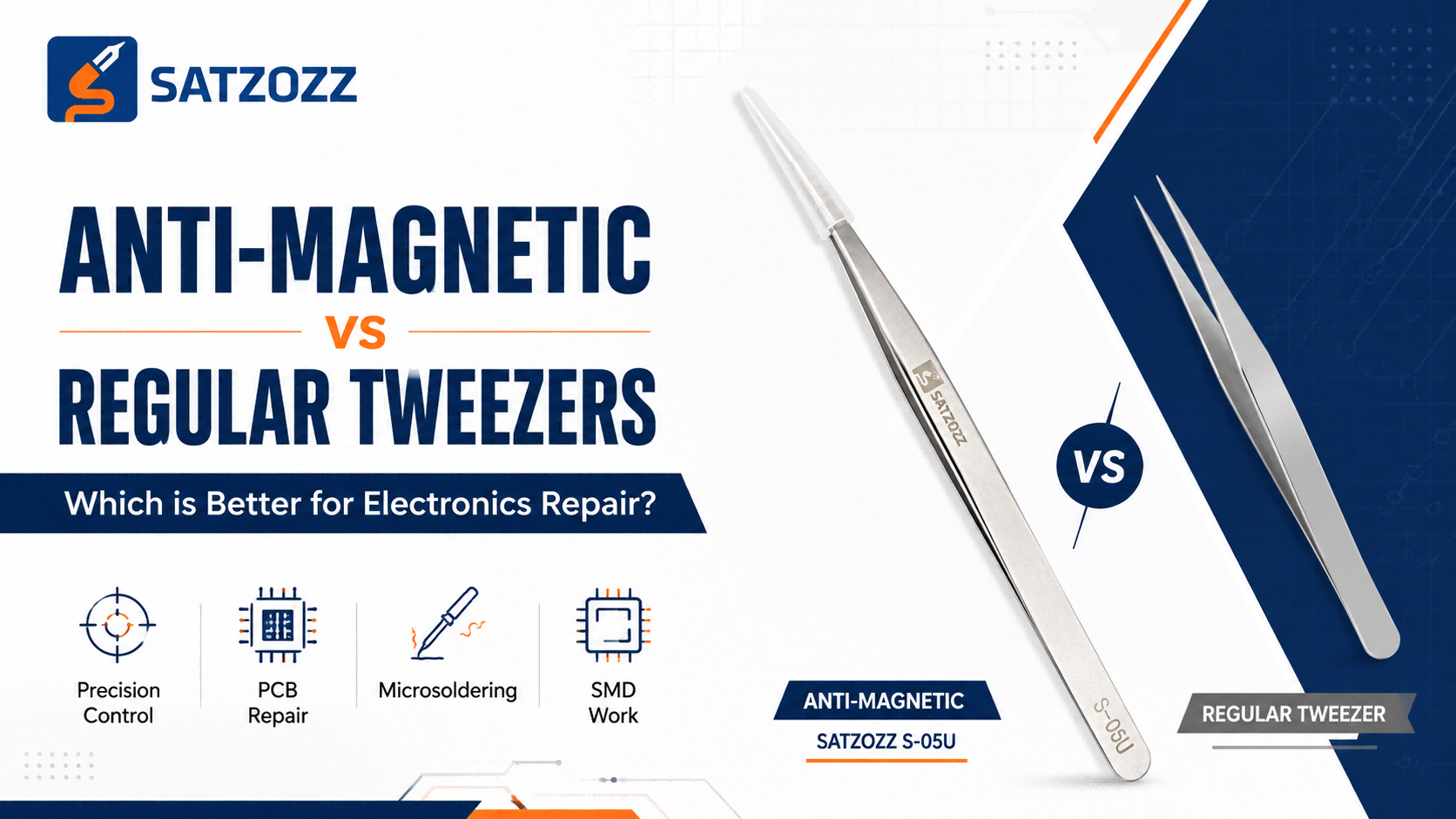
LINE
Anti-magnetic tweezers are most useful when unwanted attraction to small ferromagnetic parts can interfere with positioning or release. For many ordinary PCB tasks, a well-made regular precision tweezer can still work perfectly well. Tip geometry, alignment and grip quality often matter more than the label alone.
Precision electronics work frequently involves components and hardware small enough that tiny changes in grip, alignment or release behavior become noticeable.
Magnetic attraction is one of those variables. A tweezer that attracts a small steel screw, spring, shield fragment or other ferromagnetic part can make controlled placement more difficult.
This is why anti-magnetic or low-magnetic tweezers are commonly offered for precision electronics and laboratory work.
What Does Anti-Magnetic Mean?
Reduced unwanted attraction—not a magical absence of magnetism.
In the context of precision tweezers, “anti-magnetic” generally describes a tool designed to reduce unwanted attraction to ferromagnetic parts.
It should not automatically be interpreted as absolutely zero magnetic permeability under every condition.
The practical goal is simple: the tool should not noticeably pull tiny steel parts away from the position chosen by the technician.
Anti-Magnetic vs Regular Tweezers
The differences that actually matter at the repair bench.
| Comparison | Anti-Magnetic Tweezers | Regular Tweezers |
|---|---|---|
| Magnetic attraction | Designed to minimize it | May vary by material and processing |
| Tiny steel hardware | Easier controlled release | May attract some parts |
| SMD component placement | Excellent | Excellent when tips are precise |
| PCB debris removal | Reduced attraction to ferromagnetic debris | Behavior depends on tool material |
| Fine mechanical parts | Often preferable | Suitable for non-magnetic parts |
| ESD protection | Separate specification | Separate specification |
| Most important quality factor | Tip alignment and finish | Tip alignment and finish |
When Do Anti-Magnetic Tweezers Matter Most?
Their value depends on what you actually handle.
Tiny Steel Screws
Small repair screws can stick to a magnetic tool and become difficult to release in an exact position.
ANTI-MAGNETIC HELPSFine Springs & Mechanical Parts
Small ferromagnetic springs and mechanical pieces may be easier to position when the tweezer does not pull them unexpectedly.
ANTI-MAGNETIC HELPSSMD Resistors & Capacitors
Many standard chip components are not strongly attracted by a magnet, so tip fineness and alignment may matter more than anti-magnetic behavior.
TIP QUALITY MATTERS MOSTMicroscope PCB Work
At high magnification, even slight unwanted movement becomes noticeable. Consistent release behavior can improve control.
LOW ATTRACTION IS USEFULMetal Shield Debris
Small steel fragments or shielding pieces may follow a magnetic tool instead of remaining where the technician intends.
ANTI-MAGNETIC HELPSGeneral Wire Positioning
For copper wire and most ordinary soldering tasks, precision, ergonomics and tip shape often matter more.
REGULAR CAN BE FINEAnti-Magnetic Is Not the Same as ESD-Safe
These specifications solve two different problems.
Controls magnetic attraction
The goal is to reduce unwanted attraction between the tool and ferromagnetic parts.
This primarily affects mechanical handling and placement.
Controls electrostatic discharge
ESD-safe tools are designed to manage electrostatic charge around sensitive electronic components.
This concerns electrical protection rather than magnetism.
“If a tweezer is anti-magnetic, it must also be ESD-safe.”
False. A tool can be anti-magnetic without having an electrostatic-dissipative coating or other ESD-control design. Check both specifications separately when ESD protection matters.
Does Stainless Steel Automatically Mean Anti-Magnetic?
No. Material grade alone does not tell the whole story.
Stainless Steel ≠ Guaranteed Zero Magnetic Attraction
Austenitic stainless steels are widely used where relatively low magnetic response is desirable, but magnetic behavior can depend on alloy composition and material condition.
Manufacturing operations such as forming and cold working can also influence the final magnetic response of some stainless-steel parts.
Therefore, a specification such as 304 stainless steel tells you about the base material, but it should not be treated as a guarantee that every finished tweezer will have identical magnetic behavior.
For a precision tool, evaluate the complete product specification: material, tip processing, magnetic behavior, tip alignment and intended application.
Which Tweezers Should You Choose?
Use the repair task instead of the marketing label as your guide.
Do you frequently handle tiny steel parts?
Screws, springs, shield fragments and similar hardware.
Do you mainly place SMD passives?
Tip fineness and alignment may be more important.
Are you working on ESD-sensitive electronics?
Check the ESD specification separately from magnetism.
Do your current tweezers release parts poorly?
Check contamination, alignment and magnetic attraction.
Are you doing precision microscope work?
Predictable grip and release become increasingly important.
How to Evaluate Precision Tweezers
Magnetic behavior is only one part of the buying decision.
Before choosing a pair, check:
- Whether both tips meet evenly under magnification
- Whether the tip is fine enough for your smallest component
- Whether the surface contains burrs or rough grinding marks
- Whether the spring force feels comfortable during long sessions
- Whether small steel hardware shows unwanted attraction
- Whether the product has a separate ESD specification if required
- Whether the tip shape matches your working angle
Also read: Straight vs Curved Precision Tweezers: Which Is Better for SMD Repair?
S-05U Ultra-Fine Precision Tweezers
SATZOZZ S-05U is designed for detailed electronics repair and microsoldering applications where fine component control is required.
- 304 stainless steel
- Anti-magnetic design
- Ultra-fine precision tip
- Hand-finished 3D tip
- Small SMD handling
- PCB microsoldering applications
Anti-Magnetic Tweezers Questions
Quick answers for electronics repair technicians.
What are anti-magnetic tweezers?
Anti-magnetic tweezers are precision tools designed to minimize unwanted magnetic attraction to ferromagnetic components and small metal parts.
Are anti-magnetic tweezers better for electronics?
They can be advantageous when handling small ferromagnetic parts, but tip precision, alignment and ergonomics remain important for ordinary PCB and SMD work.
Are anti-magnetic tweezers the same as ESD tweezers?
No. Anti-magnetic describes magnetic behavior, while ESD-safe describes electrostatic-control properties. A tool may have one, both or neither specification.
Are 304 stainless-steel tweezers non-magnetic?
304 stainless steel is an austenitic stainless grade, but the magnetic behavior of a finished tool can vary with composition and processing. The complete tweezer specification should be considered.
Do anti-magnetic tweezers help with SMD components?
They can improve predictable handling when magnetic attraction is present, but many ordinary SMD components are better influenced by tip geometry, alignment and gripping quality than by magnetism alone.
How do I know if my tweezers are magnetic?
Observe whether the clean tweezer tips noticeably attract a small known ferromagnetic part such as a steel screw. For professional specification, rely on the manufacturer’s stated tool properties.
Which tweezers should I buy first for PCB repair?
Start with a high-quality fine-tip precision tweezer that matches your typical component size. Low magnetic attraction is a useful additional feature for detailed electronics repair.
Better Control Starts With the Right Tool
Explore SATZOZZ precision tweezers for SMD repair, PCB rework and microsoldering applications.