
Straight vs Curved Precision Tweezers
Which tip geometry gives better control for SMD placement, microsoldering, microscope work and hot-air PCB rework?
- Precise placement
- Direct alignment
- Microscope work
- Improved visibility
- Side approach
- Hot-air rework
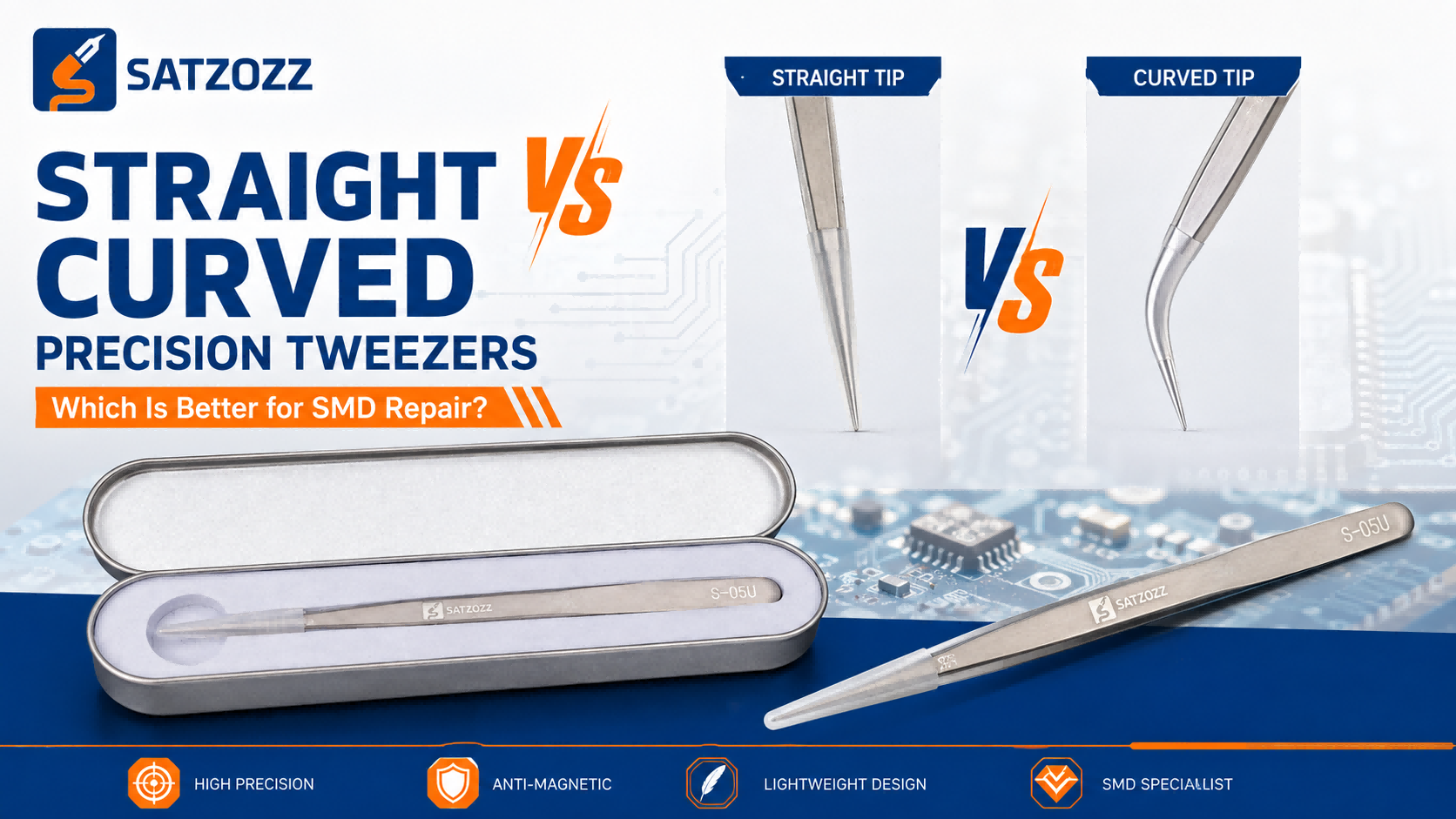
VERDICT
Straight Tip
The better first choice for tiny SMD placement, direct component alignment and general precision PCB work.
Curved Tip
Better when visibility, side access or clearance around surrounding components becomes more important.
Precision tweezers are among the most frequently used hand tools in PCB repair. They help technicians position small components, manipulate fine wires, remove debris and lift components during soldering or hot-air rework.
Straight and curved tweezers perform the same basic gripping function, but their different tip geometry changes the working angle, visibility and way hand movement is transferred to the component.
The Core Difference
Straight tips prioritize direct control. Curved tips prioritize access.
Direct hand-to-tip control
The gripping point remains closely aligned with the main body of the tool, giving technicians a natural relationship between finger movement and tip movement.
- Direct vertical approach
- Accurate small-part placement
- Predictable component rotation
- Excellent general-purpose control
Offset grip for better access
The angled gripping point allows the technician to keep the hand and tool body farther away from the target component.
- Improved visibility
- Access around tall parts
- Side-entry positioning
- Convenient hot-air rework
Performance Comparison
Practical strengths for common electronics repair tasks.
Which Tip Is Better for Real PCB Repair?
Match the geometry to the job.
Straight ultra-fine tips are usually better.
Small resistors, capacitors and diodes benefit from a direct approach because the technician can control position, rotation and release more predictably.
Curved tips often provide an access advantage.
The angled geometry can keep the hand farther from the direct hot-air stream and allow the package to be approached from the side.
Visibility determines the answer.
Straight tweezers provide excellent control in an open field. Curved tweezers can be better when the tool body or your hand blocks the microscope view.
Best Tweezer Shape by Task
A quick reference for the repair bench.
| Repair Task | Suggested Tip | Reason |
|---|---|---|
| Small resistor / capacitor | Straight | Direct, predictable grip. |
| Fine SMD placement | Straight | Excellent alignment control. |
| Hot-air component removal | Curved | Better side access and hand clearance. |
| Dense PCB area | Curved | Easier access around nearby parts. |
| Microscope positioning | Straight / Curved | Depends on field visibility. |
| Vertical component lift | Straight | Direct upward force path. |
| Wire under obstacles | Curved | Improved angled reach. |
| General microsoldering | Straight | Most versatile first choice. |
Tip Shape Is Only Half the Story
Precision also depends on manufacturing quality.
Tip Fineness
The tip must reach the component without contacting adjacent parts.
Tip Alignment
Both jaws should meet evenly at the intended gripping point.
Tip Symmetry
Uneven tips can rotate tiny components during gripping.
Surface Finish
Clean finishing reduces burrs and unwanted scratching.
Magnetic Behavior
Low magnetic attraction can improve small-part release.
Spring Tension
Appropriate tension reduces fatigue during precision work.
How to Choose Precision Tweezers
Use the following decision process.
Start With Component Size
Choose a tip fine enough for the smallest parts you regularly handle.
Evaluate the Working Angle
Straight tips favor direct access. Curved tips help when the path is obstructed.
Inspect Tip Alignment
Both tips should meet consistently under magnification.
Check Surface Quality
Avoid burrs, damage or uneven grinding.
Consider Magnetic Behavior
Unwanted magnetic attraction can make component release difficult.
Check Hand Comfort
Spring force should allow long repair sessions without excessive fatigue.
Precision Tweezer Mistakes
Ultra-fine tools require careful handling.
Using Tweezers to Pry
Side force can permanently bend ultra-fine tips.
Use a dedicated pry tool instead.Excessive Grip Pressure
Tiny parts may suddenly shoot away from the tips.
Use only enough pressure for a stable grip.Forcing Components During Rework
Mechanical force can damage PCB pads.
Lift only after the solder has released.Ignoring Damaged Tips
Bent tips reduce placement accuracy.
Inspect tips regularly under magnification.S-05U Ultra-Fine Precision Tweezers
Designed for detailed PCB repair and microsoldering applications requiring controlled handling of very small components.
- 304 stainless steel
- Non-magnetic design
- Ultra-fine precision tip
- Hand-finished 3D tip
- SMD component handling
- PCB microsoldering applications
Precision Tweezers Questions
Quick answers for PCB repair technicians.
Are straight or curved tweezers better for SMD work?
Straight tweezers generally provide better direct control for tiny component placement. Curved tweezers are useful when direct access is blocked.
What are curved tweezers used for in electronics?
Curved tweezers are useful for side access, working around tall components, improving visibility and hot-air rework.
Which tweezers are best for tiny SMD components?
Ultra-fine straight tweezers are usually the most versatile choice because they provide direct component control.
Are anti-magnetic tweezers useful for electronics?
Yes. Reduced magnetic attraction can make small metallic parts easier to position and release.
Why do small components fly out of tweezers?
Excess grip pressure, poor tip alignment, contamination or inappropriate tip geometry can cause small components to escape.
Can precision tweezers be used during hot-air rework?
Yes. Lift the component only after its solder joints have fully reflowed.
Precision Starts at the Tip
Explore SATZOZZ precision tweezers and microsoldering tools for PCB repair and electronics maintenance.