
Desoldering Wick vs Solder Sucker: Which Tool Should You Use?
Compare solder wick and solder suckers for PCB pad cleaning, solder bridge removal, SMD rework, through-hole components and everyday electronics repair.
Quick answer: Use desoldering wick when you need precise, controlled solder removal from flat PCB pads, SMD components or solder bridges. Use a solder sucker when you need to remove a larger volume of molten solder from through-holes, terminals or component leads. For many repairs, the best method is to use a solder sucker first and desoldering wick afterward for final pad cleaning.
Desoldering wick and solder suckers are two of the most common tools used to remove solder during PCB repair. Both can help remove components and clean solder joints, but they work in very different ways.
Desoldering wick absorbs molten solder into a braided copper structure through capillary action. A solder sucker uses a spring-loaded or powered vacuum to pull molten solder away from the joint.
Choosing the correct tool can reduce repair time, improve solder removal and lower the risk of damaging PCB pads. This comparison explains where each tool performs best and when professional technicians use both together.
Choose Desoldering Wick For
- Cleaning flat PCB pads
- Removing fine solder bridges
- Fine-pitch IC and SMD rework
- Removing thin residual solder
- Preparing pads for component replacement
Choose a Solder Sucker For
- Clearing solder from through-holes
- Removing larger solder deposits
- Desoldering connectors and terminals
- Removing through-hole component leads
- Fast bulk solder removal
Desoldering Wick vs Solder Sucker at a Glance
| Comparison | Desoldering Wick | Solder Sucker |
|---|---|---|
| Operating method | Absorbs molten solder into braided copper | Uses vacuum or spring suction |
| Best for SMD pads | Excellent | Limited |
| Best for through-holes | Useful for final cleaning | Excellent |
| Best for solder bridges | Excellent | Difficult on small bridges |
| Precision | High | Medium |
| Bulk solder removal | Slower | Fast |
| Consumable required | Yes, used wick must be trimmed | No consumable for manual models |
| Learning curve | Requires heat and pressure control | Requires timing and correct nozzle position |
| Typical repair role | Precision and finishing tool | Bulk solder removal tool |
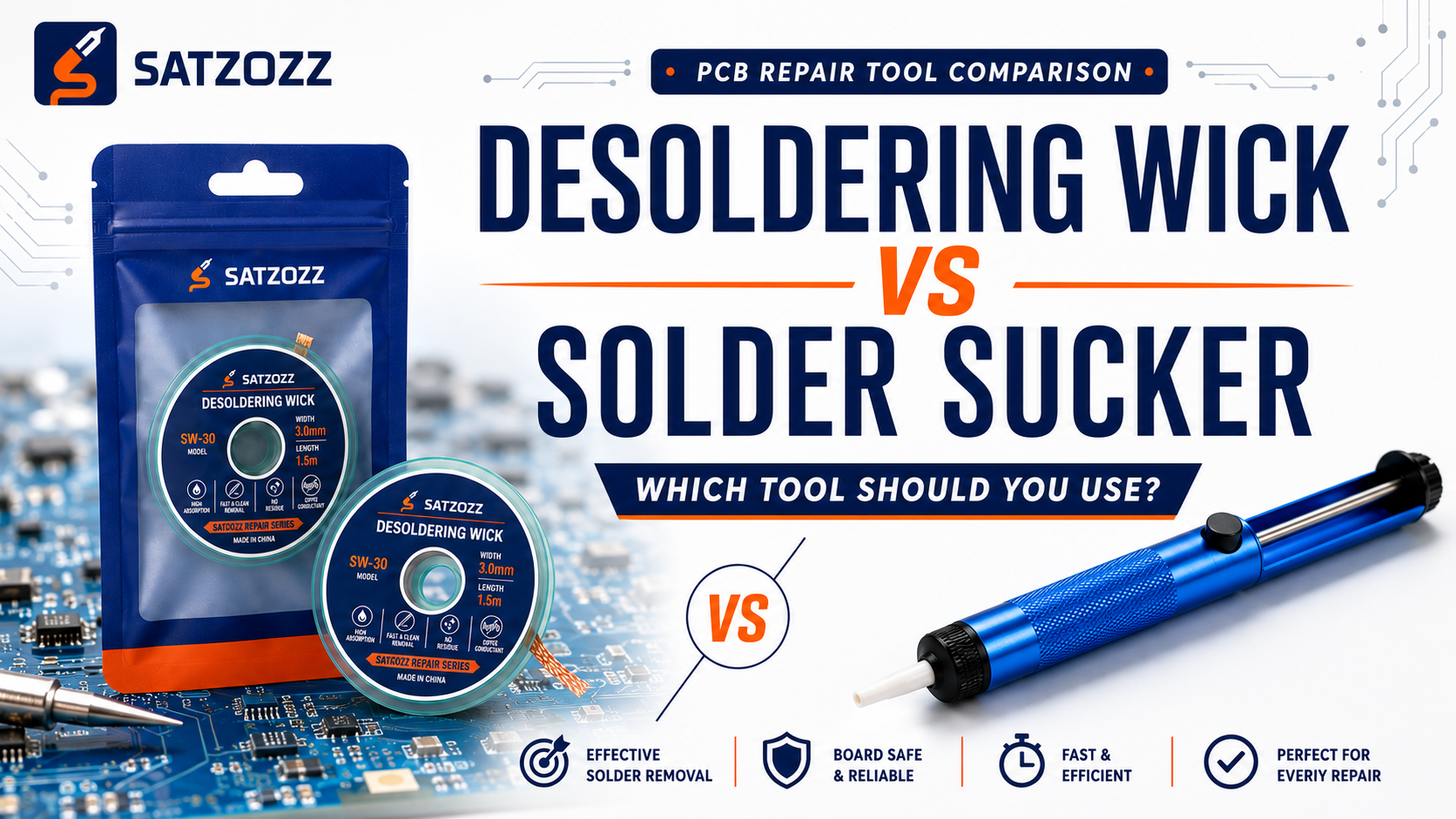
What Is Desoldering Wick?
Desoldering wick, also called solder wick or desoldering braid, is a flat strip of braided copper wire. The wick is placed directly over a solder joint, and a heated soldering iron tip is placed on top.
When the solder melts, capillary action draws it into the spaces between the copper strands. The solder-filled section is then trimmed away before the next use.
Common Uses
- Cleaning solder from PCB pads
- Removing bridges between IC pins
- Flattening pads before reinstallation
- Removing residual solder after suction
- Fine-pitch and microsoldering work
Available Widths
Different wick widths are used for different solder-joint sizes. SATZOZZ Desoldering Wick is available in five options:
- SW-10: 1.0 mm
- SW-15: 1.5 mm
- SW-20: 2.0 mm
- SW-25: 2.5 mm
- SW-30: 3.0 mm
Advantages of Desoldering Wick
- Provides precise control around small PCB pads.
- Works well on flat surfaces and fine-pitch pins.
- Can remove thin layers of residual solder.
- Helps create smooth pads for replacement parts.
- Does not produce a strong mechanical suction force.
Limitations of Desoldering Wick
- Less efficient for removing a large volume of solder.
- Requires a fresh section after the braid fills with solder.
- Wide braid requires sufficient soldering-iron capacity.
- Poor technique may expose PCB pads to excessive heat.
What Is a Solder Sucker?
A solder sucker is a tool that removes molten solder using suction. Manual versions normally contain a spring-loaded plunger. The technician melts the solder, positions the nozzle close to the joint and activates the plunger.
Powered desoldering pumps and desoldering stations combine heat and continuous suction, making them suitable for repeated through-hole component removal.
Common Uses
- Clearing solder from plated through-holes
- Removing connector pins
- Desoldering switches and sockets
- Removing large solder deposits
- Repairing through-hole circuit boards
Common Types
- Manual spring-loaded solder sucker
- Bulb-style suction tool
- Electric desoldering pump
- Temperature-controlled desoldering station
Advantages of a Solder Sucker
- Removes a relatively large amount of solder quickly.
- Works well on open through-holes and larger joints.
- Manual versions do not require replaceable wick.
- Powered stations are efficient for repetitive repair work.
Limitations of a Solder Sucker
- Less precise around small SMD components.
- The nozzle may not seal well against flat PCB pads.
- Timing must be accurate before the solder solidifies.
- Mechanical impact can disturb small or delicate components.
- It may leave a thin layer of solder behind.
Which Tool Is Better for PCB Pads?
Desoldering wick is normally the better choice for cleaning flat PCB pads. The copper braid makes direct contact with the solder and absorbs it across the pad surface.
This allows the technician to remove solder gradually and produce a flatter pad for installing a replacement component.
Recommended Tool: Desoldering Wick
Use wick for SMD pads, IC footprints, connector pads and other flat surfaces where controlled solder removal is more important than high-volume suction.
Which Tool Is Better for Through-Hole Components?
A solder sucker is normally more effective for through-hole joints because its vacuum can pull molten solder out of the hole.
Desoldering wick can remove solder around the component lead, but it may not always clear the solder from deep inside the plated hole.
Recommended Tool: Solder Sucker First
Use a solder sucker to remove the bulk of the solder. After the component is removed, use desoldering wick to clean residual solder from the surrounding pad.
Which Tool Is Better for Solder Bridges?
Narrow desoldering wick is usually the better tool for removing solder bridges between closely spaced pins.
A solder sucker nozzle is often too large to isolate a small bridge and may disturb neighboring solder joints. Wick allows heat and absorption to be directed more precisely.
Recommended Tool: Narrow Desoldering Wick
Use 1.0 mm or 1.5 mm wick for fine-pitch components and narrow solder bridges. Use magnification and controlled heating to avoid affecting adjacent pins.
Which Tool Is Better for Large Solder Joints?
Large connectors, shielding tabs, power terminals and heavy through-hole joints often contain more solder than a small section of wick can absorb efficiently.
A solder sucker can remove the main solder volume more quickly. Wider wick can then be used for final surface cleaning.
Recommended Method: Use Both Tools
Remove the main solder deposit with suction, then finish the repair with 2.5 mm or 3.0 mm desoldering wick where appropriate.
Can Desoldering Wick and a Solder Sucker Be Used Together?
Yes. In many professional repair workflows, the two tools are complementary rather than competing alternatives.
Melt the Solder Joint
Heat the solder until it flows evenly. Add a controlled amount of flux or fresh solder when necessary to improve wetting.
Remove the Bulk Solder
Use a solder sucker or desoldering pump to remove the largest amount of molten solder from the joint or through-hole.
Inspect the Remaining Solder
Check the pad, hole and component lead under magnification.
Clean the Pad With Wick
Use appropriately sized desoldering braid to remove thin residual solder and create a clean, flat repair surface.
Desoldering Wick or Solder Sucker for Common Repair Tasks
| Repair Task | Preferred Tool | Reason |
|---|---|---|
| Cleaning SMD component pads | Desoldering wick | Provides controlled surface cleaning |
| Removing solder bridges | Desoldering wick | Narrow braid can target small areas |
| Clearing a plated through-hole | Solder sucker | Vacuum removes solder from inside the hole |
| Removing a through-hole connector | Solder sucker or station | Better for multiple large solder joints |
| Cleaning pads after connector removal | Desoldering wick | Removes residual solder and flattens the pad |
| Fine-pitch IC rework | Desoldering wick | Offers greater control around closely spaced pins |
| Removing solder from a power terminal | Use both | Suction removes volume; wick finishes the surface |
| General beginner repair kit | Keep both | Each tool covers different repair situations |
Which Tool Is Safer for Delicate PCB Pads?
Either tool can damage a circuit board when used incorrectly. Desoldering wick may overheat a pad if held in place too long, while a solder sucker can introduce mechanical movement or impact near delicate components.
For flat, delicate and closely spaced pads, desoldering wick generally offers more control. The key is to use the correct width, efficient heat transfer and short heating cycles.
- Use a clean, properly tinned soldering iron tip.
- Match the wick width to the solder joint.
- Use fresh braid rather than a saturated section.
- Apply light pressure only.
- Lift the iron and wick together while solder is molten.
- Allow the PCB to cool between repeated attempts.
Read: How to Use Desoldering Wick Without Damaging PCB Pads .
Why Is Desoldering Wick Sometimes Not Working?
Wick performance depends on soldering-tip condition, temperature, flux, positioning and braid width. If the solder melts but does not enter the wick, stop heating and identify the cause.
- The soldering iron tip may be dirty or oxidized.
- The wick may already be saturated.
- The selected braid may be too wide for the tip.
- The joint may need additional flux.
- The wick may not contact the solder directly.
- The joint may have high thermal mass.
For a complete diagnosis, read: Why Is My Desoldering Wick Not Absorbing Solder?
What Should Beginners Buy?
A basic PCB repair kit should ideally contain both a manual solder sucker and several widths of desoldering wick.
The solder sucker handles larger through-hole joints, while the wick cleans pads, corrects solder bridges and supports precision SMD work.
For general use, 2.0 mm wick is a practical starting size. Technicians working on fine-pitch boards should also keep 1.0 mm or 1.5 mm braid available.
Frequently Asked Questions
Is desoldering wick better than a solder sucker?
Desoldering wick is better for flat PCB pads, solder bridges and precision SMD work. A solder sucker is better for removing larger amounts of solder from through-holes and terminals.
Can I use desoldering wick instead of a solder sucker?
Yes, for many flat pads and small joints. However, a solder sucker may be more efficient when clearing a large amount of solder from a through-hole.
Can a solder sucker remove solder bridges?
It may remove some solder, but narrow desoldering wick normally provides better control for bridges between closely spaced component pins.
Should I use wick after a solder sucker?
Yes. Wick is useful for removing residual solder after suction and creating a flatter, cleaner PCB pad.
Which tool is better for through-hole components?
A solder sucker or powered desoldering station is usually better for clearing solder from inside plated through-holes.
Which tool is better for SMD repair?
Desoldering wick is generally better for SMD pads, fine-pitch pins and surface solder cleanup because it provides more precise control.
What desoldering wick width should beginners use?
A 2.0 mm wick is a useful general-purpose size. Use 1.0 or 1.5 mm braid for finer work and 2.5 or 3.0 mm braid for larger solder joints.
Do professional repair technicians use both tools?
Yes. Technicians often use suction for bulk solder removal and wick for final pad cleaning, solder bridge correction and precision finishing.
Choose SATZOZZ Desoldering Wick for Precision Solder Removal
SATZOZZ Desoldering Wick is designed for PCB pad cleaning, solder bridge removal, SMD rework and electronics maintenance.
- Five widths from 1.0 mm to 3.0 mm
- Models SW-10, SW-15, SW-20, SW-25 and SW-30
- 1.5 meters of braided copper wick per roll
- Individual resealable retail packaging
- Single-model and mixed-width options
- Wholesale and private-label cooperation available
Need Desoldering Wick for PCB Repair?
Explore the SATZOZZ Desoldering Wick range or contact us for wholesale, distributor and private-label inquiries.
View Desoldering Wick Contact SATZOZZ